 EN
EN
 AR
AR
 BG
BG
 HR
HR
 DA
DA
 NL
NL
 FI
FI
 FR
FR
 DE
DE
 EL
EL
 HI
HI
 IT
IT
 JA
JA
 KO
KO
 NO
NO
 PL
PL
 PT
PT
 RO
RO
 RU
RU
 ES
ES
 SV
SV
 TL
TL
 ID
ID
 SR
SR
 UK
UK
 HU
HU
 TH
TH
 TR
TR
 GA
GA
 BE
BE
 BN
BN
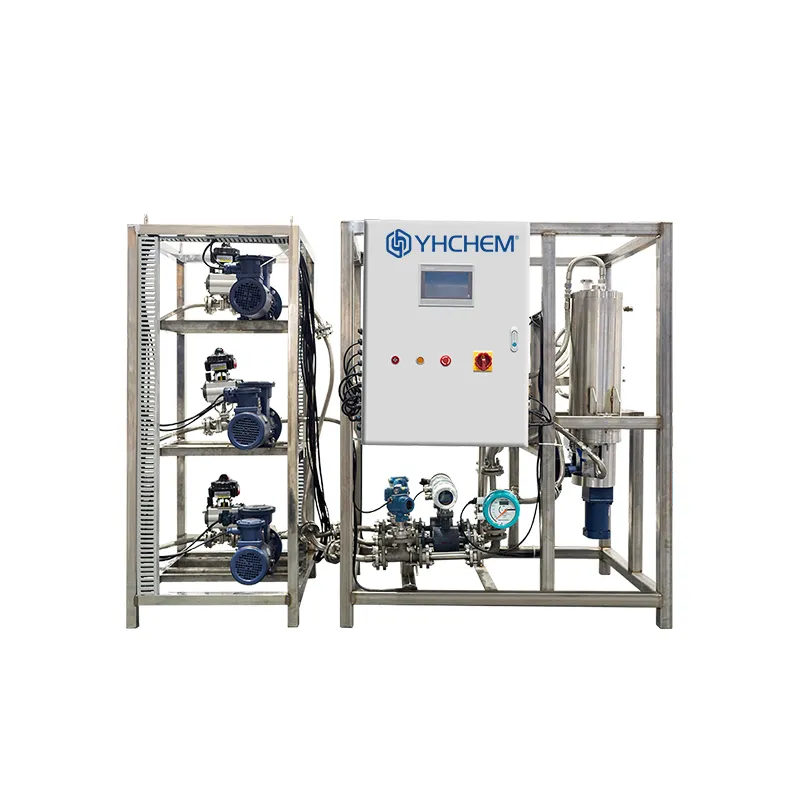
Scaling up- The process of taking a successful laboratory process and making it an entire manufacturing process is not only a needed process but also a difficult one. High expectations of a flask do not necessarily translate into a viable, effective and profitable production line. At YHCHEM, the strategy of scale-up is based on YHCHEM’s role in system integration, which has been founded by designing and implementing integrated system to more than 1,000 enterprises across the globe. YHCHEM is aware of the fact that scale-up is a complex process than mere equipment as such requires the close interaction of the design team and technology provider to carry through a project smoothly through molecule development to market introduction.
In this paper, YHCHEM has explained the main concepts of design used to construct chemical processing systems.
Phase 1: Data gathers and Process delineation.
A successful scale-up is based on the laboratory bench. It starts with making a chemical recipe be translated into a clear production process.
YHCHEM works with the customers in defining the key process parameters that ensure quality of the products such as temperature, pressure, mixing intensity, addition rates and distillation cut points. The determination of acceptable ranges of these parameters is of high priority.
Complete Material Characterization: The action entails the testing of material qualities in additional manners, other than by just the chemical composition. All the feedstocks and intermediates of YHCHEM are investigated to fully consider the physical characteristics such as the viscosity, boiling points, corrosiveness, and fouling properties. YHCHEM is based on the correct lab data to compute the whole process flow and thermal energy required in production. The possibility of the bottlenecks (heat loads or unusual separation) can be identified under this initial modelling effort with the outcome of no significant funding of financial resources being committed.
Phase 2: Pilot-Scale validation: The Relationship Bridge.
Not taking the pilot phase is a risky approach. A pilot plant is an experimental facility where the researchers can expose the production process to real world. Pilot system is employed to check the consistency of the process of producing the desired volume.
Modular pilot plants provided by YHCHEM enable researchers to investigate the behavior of larger-scale equipment through the simulation of the real-world behavior, such as scaled-up tests of kinetics, heat transfer, mass transfer, and separation.
Organizations are now able to substantially respond to unexpected difficulties at an affordable cost, e.g. foaming, formation of by-products and solid deposition. The information obtained enables the group to perfect the critical process parameters, which will be the foundation of ultimate engineering design package.
YHCHEM can provide complete pilot systems assemblies such as reactors, thin-film evaporators and distillation columns so that clients can test whole process-costumes in a closed system. This makes all the unit functions in the system interrelate properly and makes sure that they will be able to function in greater throughput levels.
Phase 3: Enterprise-scale System Design.
After the pilot data has been verified, the layout of the industrial-scale processing line enters into the sophisticated engineering step. YHCHEM is sure that the full integration of the system is the key to the operational success.
Equipment Choice and Sizing: Pilot data gives the exact data that is necessary in order to scale each equipment to every unit activity correctly. The output of the reactor also needs to be carefully defined to be able to guarantee that the systems that follow it, including concentrators and distillation columns, might suitably address their needs.
The Element of Integration: Developing a Coherent Flow.
Integration Thermal: One of the critical designs is energy efficiency. The recovery of the heat may using a condensing column vapor stream, as an example, which gathers the heat, which is employed to preheat the reactor feed.
Transport of Material: Liquids, pastes, and vapors should all be safely and controlled transported between units.
Automation and Control Philosophy: Requirement of Strong Process Control. One of the main aspects managed by the centralized control system of YHCHEM is the order of operation and the maintenance of all the important parameters at or under acceptable levels to ensure uniformity in the quality of batches.
Design of Operational Excellence: The design and layout of the system should be designed with safety, maintenance accessibility and operational flexibility. YHCHEM considers:
Modular/Accessible Layout: The equipment will be organized so that it ensures operator safety, easy sampling and maintenance and provides an opportunity to make changes in future.
Construction Materials: The level of corrosion protection, and purity of products determine the type of material to be used, be it glass, stainless steel, or specialty alloys, so the pilot plant is the same as the full scale plant.
Inherent Safety: A series of pressure relief, emergency cooling and containment systems are designed into an overall system of safety.
Phase 4: Fabrication, Commissioning and Knowledge transfer.
The last design stage is the implementation of the project.
YHCHEM produces all their equipment as per the factory-quality standards such as high-purity glass systems to make them visible or the corrosion-resistant, polished stainless steel to make it durable.
Commissioning is a three phased procedure wherein there is installation, the complete system testing followed by the ultimate phasing with the actual process material.
YHCHEM’s delivery goes beyond hardware. YHCHEM gives in depth records and pass YHCHEM’s know-how in the process to your team enabling them to manage the production line in a sustainable and efficient manner.
The YHCHEM Advantage: Your One-Stop Guide to the Scale-Up Process.
The system to scale to full production level demands multi disciplinary skills. YHCHEM has a differentiated strategic advantage:
Experience in the End-to-End: YHCHEM delivers all the required functions of the unit, i.e. Lab reactors to distillation columns, and assures them to be fully intertwined into a series of functioning.
Having Proven Scalability: YHCHEM has an established history of successfully accomplishing scale-up projects, and have the ability to design and produce equipment at laboratory, pilot and industrial scales.
International Operations: YHCHEM has the advantage of applying life experience by designing with clients in the biopharmaceutical, new energy, and petrochemical industry in 100 countries.
Conclusion
The line of chemical processing that is designed in a strategic manner is a strong business resource. Join YHCHEM’s scale-up platform (and pilot testing, subsequent design of the entire system, reduces the risks) to allow your company to minimize threats, speed up the introduction of a product, and maintain the efficiency of production in the long-term. YHCHEM has come to make your success in the laboratory an operational reality.
Poised to expand your business? Contact YHCHEM today. YHCHEM’s engineering department is willing to collaborate with you in your next endeavor, through idea to full size chemical processing line.
Table of Contents
- Phase 1: Data gathers and Process delineation.
- Phase 2: Pilot-Scale validation: The Relationship Bridge.
- Phase 3: Enterprise-scale System Design.
- The Element of Integration: Developing a Coherent Flow.
- Phase 4: Fabrication, Commissioning and Knowledge transfer.
- The YHCHEM Advantage: Your One-Stop Guide to the Scale-Up Process.
- Conclusion