
 EN
EN
 AR
AR
 BG
BG
 HR
HR
 DA
DA
 NL
NL
 FI
FI
 FR
FR
 DE
DE
 EL
EL
 HI
HI
 IT
IT
 JA
JA
 KO
KO
 NO
NO
 PL
PL
 PT
PT
 RO
RO
 RU
RU
 ES
ES
 SV
SV
 TL
TL
 ID
ID
 SR
SR
 UK
UK
 HU
HU
 TH
TH
 TR
TR
 GA
GA
 BE
BE
 BN
BN
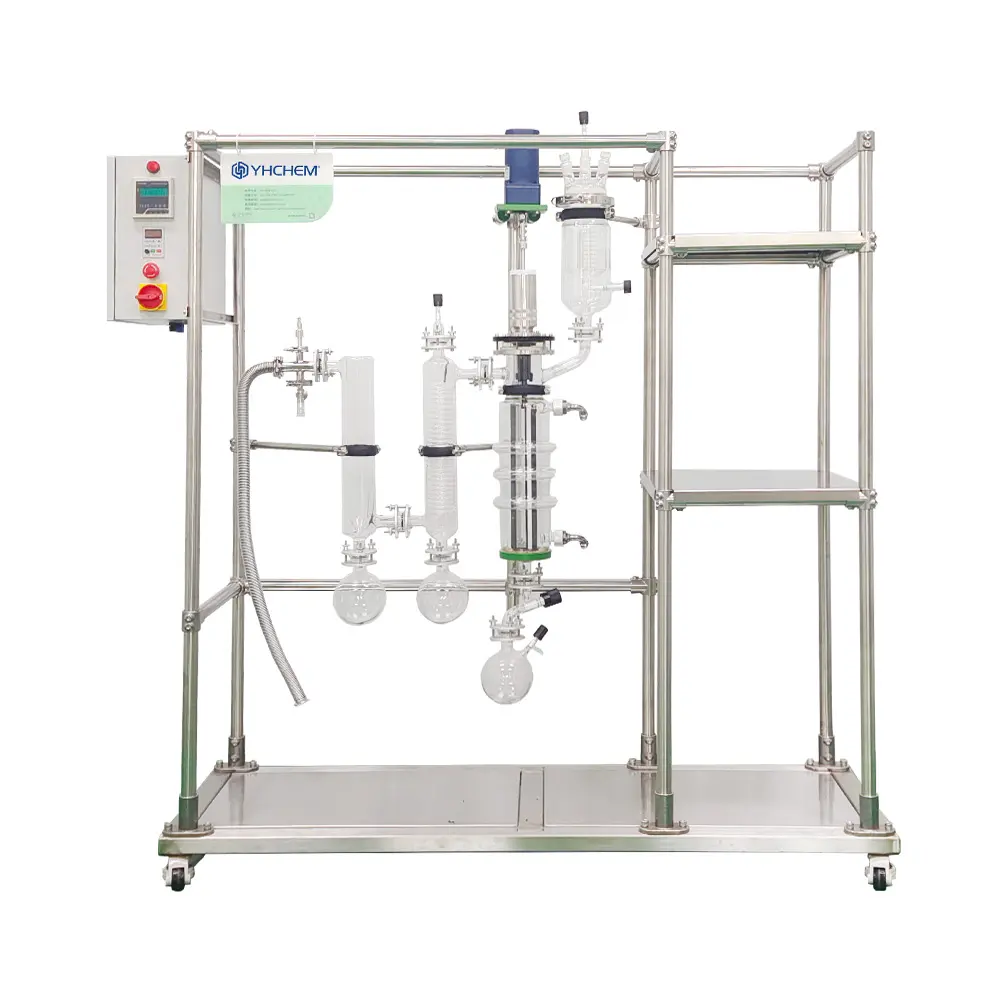
The engineering of integrated chemical processes requires not only a technical decision when choosing the best separation technology but also a strategic decision towards efficiency quality of the product and the economic sense of the processes. Thin film Evaporators and Distillation Columns are some of the strongest weapons in our arsenal at YHCHEM. Although they both serve to separate, the working principles and the use in which they are appropriate are fundamentally different. The present guide contains the elements of decision criterion that are of critical significance at the eyes of players of both technologies and integrated system services as a provider of YHCHEM.
Core Principles: Understanding the Technologies
It is essential to know what an individual technology is good at before making the selection decision.
Thin Film Evaporation: The Science of Separating, Gentle, Fast.
The principle of operation of a thin film evaporator is that, when it makes contact with a heated surface under the vacuum, the feed material is passed on to a thin and turbulent sheet on its surface. It is the continually recycled motion picture followed out with mechanical wipers.
Key Characteristics:
Brief Lived Time: Material is heat treated over several seconds and gets rid of thermal strains.
High Heat Transfer Efficiency: This is due to the fact that the thin film can evaporate at the rapid speed.
Troublesome Feeds Manages: Viscous, messy or heat sensitive feeds which tend to jam or degenerate feed systems with other systems Excellent management.
Primary Function: The common type of a fractions separator or fractionation is used instead of a fractionator. It is advantageous in that it is efficient in the extraction of a volatile (such as a solvent) product of a less volatile (such as concentrated product or heat reactive residue) product.
Distillation Columns: The Art of Fractionation Exactness.
It is a separation technique in which a distillation column is employed in transferring that part of the components of the trays or packing with one component of varying volatilities being separated.
Key Characteristics:
Theoretical Stages: Gives a variety of equilibrium stages, which allow a great separation of constituents boiling close to one another.
High Purity and Fractionation: It is capable of producing multiple and high purity streams of products that have a single feed line.
Longer Residence Time: Material is taken longer in the column and this can be toxic to thermal sensitive material.
Primary Function: It is a fractionator. It is defined by its advantage of isolating myriads of ingredients in the mixture with high level of purity.
Decision Matrix: Selecting the Right Technology
Instead, it will depend on the feed material and goals of the process to decide on thin film evaporator and either no distillation column or both. YHCHEM selection criteria is grounded on four pillars:
1. Thermal Stability of Feed Material.
Selection of Thin film Evaporator: Select when: Processing sensitive materials like vitamins, natural extracts, or some polymers, or pharmaceutical intermediates. Decomposition, polymerization or discoloration are inhibited by the brief exposure to heat.
Use a Distillation Column when: The feed materials must be thermally stable and capable of withstanding the more extended residence times and temperature distributions of multi stage fractionation.
2. Feed Viscosity and Fouling Potential.
Use Thin film Evaporator in cases: When dealing with viscous, sticky or slurry-like products or mixtures that crystallize or foul. The wiping is mechanized, which helps to keep the surface of heating clean and efficient.
Use a Distillation Column where: The feed is a free-flowing liquid that is not vulnerable to fouling. Columns may be susceptible to solids or polymerising feeds and this can lead to flooding or fouling of trays/packings.
3. Separation Objective
Use Thin film Evaporator when: It is desired to separate bulk- e.g. to strip solvents off a product, to concentrate a product, or remove light/ heavy ends off a primary product. Its best application is in a single stage evaporation.
Select a Distillation Column when: The desired product is high-purity fractionation- such as separation of solvent mixtures (e.g. mixture of three solvents), purification of an intermediate (e.g. removal of solvent isomers), purification to a specific purity specification (e.g. 99.90%+).
4. Volatility Difference between Components.
Use Thin film Evaporator when: The difference in volatility between the separating components (e.g. ethanol and a resin, water and a concentrated syrup) is large.
Select a Distillation Column when: The components close boiling point and must be processed through more than where three equilibrium stages are needed to obtain the desired purity.
The Power of Integration: Sequential Use for Optimal Results
In a highly developed processing, the most beautiful processing is probably to combine both technologies in series. YHCHEM focuses on the design of these integrated systems, each of which is designed to accomplish another task, which it is most suitable to handle.
A Standardized Integrated Operation: Thin film Evaporator-Distillation column.
This is an extremely productive step towards the purification of a heat vulnerable product into a complicated reaction mixture.
Stage 1 - Thin film Evaporator (The Conditioner): The feed material consisting of the crude reaction mixture which can be viscous and containing the heat-sensitive components is pumped to the thin film evaporator. Most importantly, it inhibits the down-stream column through the extraction of foulants and thermolabile substances.
Stage 2 - Distillation Column (The Refiner): The concentrated and stabilized residue, which has been obtained so far with the thin film evaporator, enters the distillation column. The column then carries out the multi-stage fractionating of the exact amount that is required to extract the final high-purity product out of other components which react similarly at the same boiling point. The feed is already cleaned and concentrated by the thin film evaporator and therefore the column is more effective to operate and require less energy than in case it had not been cleaned, and it is also more reliable since it has a smaller diameter.
Application: Pharmaceutical API Purification.
A reactor is utilized to make a heat-sensitive API. In low temperature a YHCHEM thin film evaporator removes >95% of the solvents. The concentrated API mixture is then pumped into a short path or molecular distillation column to give final and ultra high-purity separation between reaction by-products. This combined strategy brings out maximum yield, maintains the API integrity and purifies end yield.
The YHCHEM Advantage: Unbiased Guidance and Seamless Integration
YHCHEM is an independent consultancy as they are both manufacturers of thin film evaporators making them unbiased, only aiming at the optimum result of your process. With our integrated system design we will have:
Perfect Hydraulic and thermal coupling: The operating parameters and size throughout the two units are optimized.
Material Compatibility: Use of consistent materials in the system, e.g. glass or certain alloys of stainless-steel.
Integrated Control: One automation system with effective control.
Conclusion: Making an Informed Strategic Choice
There is no question of which technology is better in choosing the thin film evaporation compared to the distillation, but rather which one best suits the occasion. To achieve the tricky separations with delicate feeds or complex feeds, the combined application of the thin film evaporator with the distillation column may embody the most desirable process design.
We provide you with technologies and the skills required to implement them at YHCHEM. We have more than 1,000 customers in 100 countries under our belt, and we know how to guide you through this crucial decision and design an engine that would achieve optimal performance, all the way to the last feed to the finished product.
Not sure what separation technology to use in your combined process? Call the engineering department in the YHCHEM now to have an in-depth review of the process and a proposal of the custom solution.