EN
EN
 AR
AR
 BG
BG
 HR
HR
 DA
DA
 NL
NL
 FI
FI
 FR
FR
 DE
DE
 EL
EL
 HI
HI
 IT
IT
 JA
JA
 KO
KO
 NO
NO
 PL
PL
 PT
PT
 RO
RO
 RU
RU
 ES
ES
 SV
SV
 TL
TL
 ID
ID
 SR
SR
 UK
UK
 HU
HU
 TH
TH
 TR
TR
 GA
GA
 BE
BE
 BN
BN

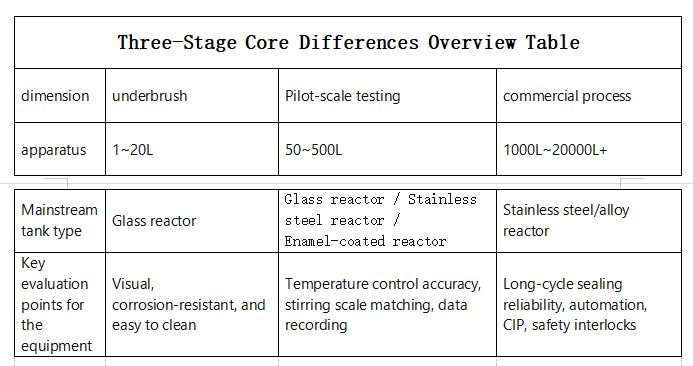
Technical copywriting for kettle applications
In the fields of chemical synthesis, pharmaceutical R&D, new material preparation and fine chemical engineering, reaction kettles serve as core process equipment. Nevertheless, many enterprises frequently encounter the following dilemmas in actual production: inability to visually monitor the reaction process leading to unstable batch quality; corrosive media posing a serious threat to equipment service life; insufficient temperature control accuracy resulting in increased by-products; and difficulties in cleaning validation affecting GMP compliance, among other issues. When the marketing and sales departments communicate with customers, the most crucial value to convey is not merely "listing technical parameters", but rather "how our equipment precisely addresses customers' process pain points".
I. Pilot Stage (1L–30L) — Exploration and Verification
Core Customer Requirements:
Low demand for absolute stability (manual intervention is allowed); multiple experiments are required under various conditional factors to identify the optimal process parameters.
Flexibility and Rapidity: Frequent adjustment of reaction conditions including temperature, pressure, feeding mode and stirring speed.
Visual Process Monitoring: Observation of key phenomena such as color change, precipitation formation, bubble generation and emulsification stratification.
Easy Cleaning and Cross-Contamination Prevention: Quick cleaning between batches to avoid interference from residual materials.
Safety Margin: Controllable losses even in case of bumping or material overflow.
To address the issue where R&D personnel cannot clearly observe or modify processes:
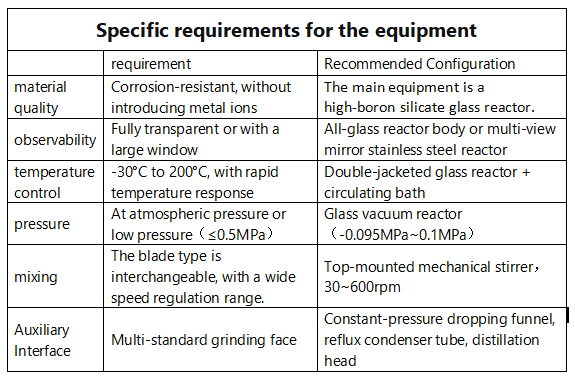
1) Full transparency ensures complete visibility throughout the reaction process, eliminating the need for "black-box guessing" —color changes, crystal precipitation, and phase separation/emulsification are all clearly observable.
2) Exceptionally corrosion-resistant, with virtually no material limitations; resistant to strong acids (hydrochloric acid, nitric acid, aqua regia) and organic solvents, without introducing metal ions.
3) Modular design enables multi-functional use in a single reactor, compatible with constant-pressure dropping, reflux, distillation, and water separation modes, featuring rapid module switching for adaptation to various synthetic routes.
4) Rapid cleaning with low cross-contamination risk: The glass surface is smooth with no dead corners, allowing visual confirmation of cleanliness and significantly reducing batch intervals.
II. Pilot Scale Stage (50L–500L) – Scale-up and Validation
Customer's primary concern: The pilot-scale test represents the first time the equipment operates under actual process loads. The client's greatest concern is that while the laboratory-scale test completes within 2 hours, the pilot-scale test requires 5 hours; additionally, no by-products are observed in the laboratory-scale test, whereas significant impurities are detected in the pilot-scale test. This discrepancy typically stems from differences in mixing efficiency and heat transfer capacity.
1) Reliable process scale-up: The results obtained under laboratory conditions remain stable upon scaling up, with no significant decrease in yield.
2) Batch-to-batch consistency: Results show minimal variation across 3–5 consecutive batches. 3) Process controllability: Parameters such as temperature, pressure, pH, and torque are recorded and traceable.
4) Safety verification: Evaluate the heat release rate, gas release volume, and stirring dead zone.
5) Cost estimation: Preliminary assessment of unit cost, energy consumption, and labor hours.
Addressing the issues of "reduced yield and batch-to-batch instability":
- Batch-to-batch consistency under real operating conditions: RSD of key parameters across five consecutive batches ≤5%, with a temperature uniformity test report provided;
- Visual extension design: A sapphire sight glass installed on the stainless steel reactor vessel allows observation of liquid level, foam, and stirring patterns even under high pressure.
- Flexible material selection addresses pilot-scale corrosion challenges: available in 316L, Hastelloy, enamel-lined, or PTFE-lined configurations, with seamless switching between media and support for performance testing using matching material specimens.
4) Parameters comply with GMP and regulatory requirements for traceability: PLC automatically records temperature, pressure, rotational speed, and torque curves, with USB export capability to meet process reporting and regulatory compliance needs.
III. Industrial Production Stage (1000L–20000L+; stainless steel reactor)
Addressing the challenges of "long-cycle stability, compliance, and low maintenance":
- Long-cycle fault-free operation design: Dual-end mechanical seals + sealing fluid circulation system with a design life ≥10 years, ensuring leak-free continuous operation for thousands of hours.
- 2) Full-process automation and safety interlocks: DCS-integrated temperature/pressure/weight/pH/mixing current monitoring with automatic overpressure/overtemperature relief/shutdown.
- 3) Efficient heat transfer and energy-saving solution: Jacket + inner coil + semi-tube combination reducing steam/cooling water consumption per batch by 15%–30%. *
- CIP/SIP-verifiable cleaning: Spraying spheres cover all areas with no dead zones; inner surface roughness Ra ≤0.4μm; provides cleaning verification conductivity data.
- User-friendly operation and rapid wear part replacement: Bottom-mounted ball/diaphragm valves allow mechanical seal replacement without motor disassembly; spare part life schedules are provided in advance.