
 EN
EN
 AR
AR
 BG
BG
 HR
HR
 DA
DA
 NL
NL
 FI
FI
 FR
FR
 DE
DE
 EL
EL
 HI
HI
 IT
IT
 JA
JA
 KO
KO
 NO
NO
 PL
PL
 PT
PT
 RO
RO
 RU
RU
 ES
ES
 SV
SV
 TL
TL
 ID
ID
 SR
SR
 UK
UK
 HU
HU
 TH
TH
 TR
TR
 GA
GA
 BE
BE
 BN
BN
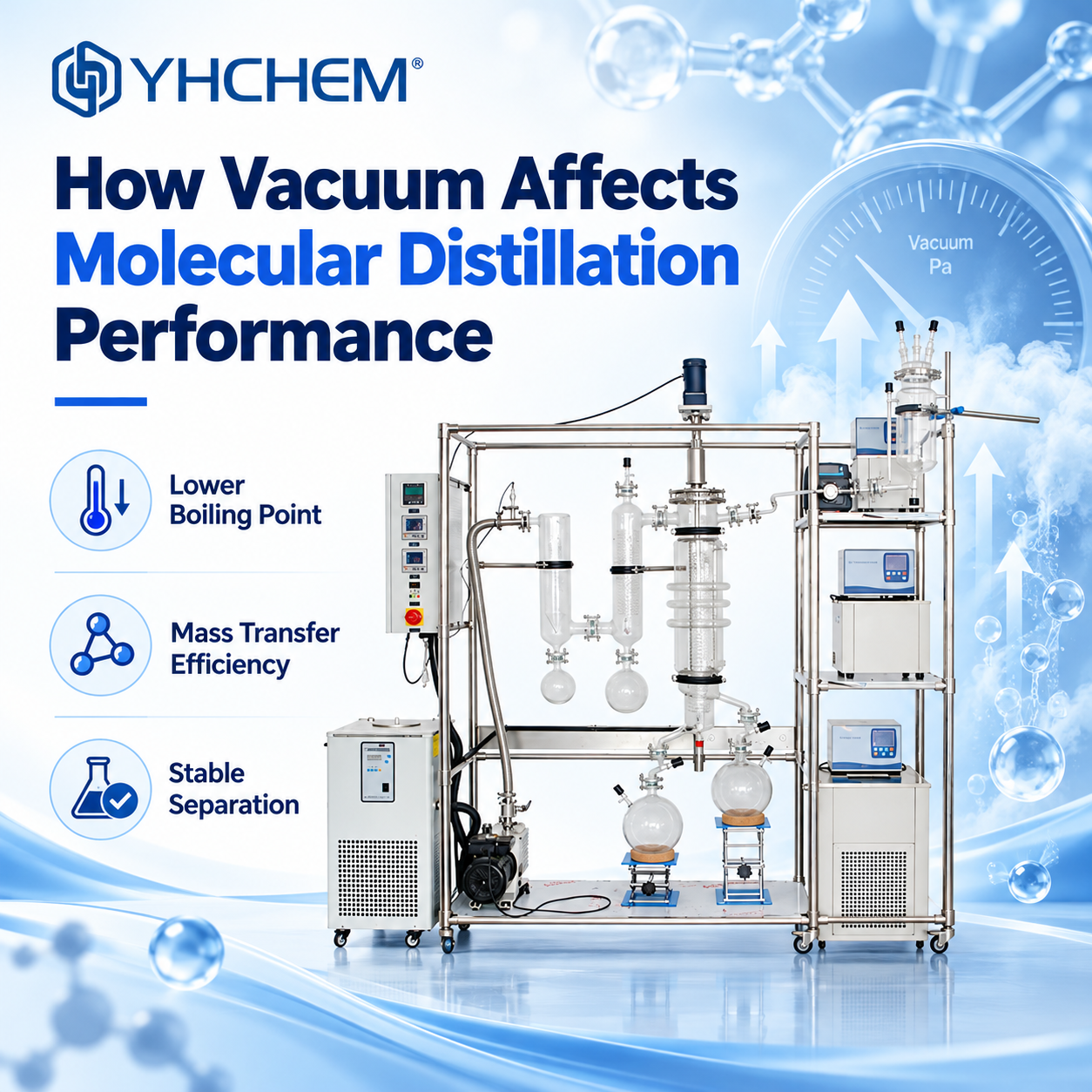
Vacuum is one of the most important operating conditions in molecular distillation. Lower absolute pressure can reduce the temperature required for volatile components to leave the liquid film and can increase the mean free path of vapor molecules, supporting short-distance transport toward the internal condenser. However, deeper vacuum is not automatically better. Separation performance also depends on feed composition, residual solvent, feed temperature, evaporation temperature, feed rate, wiper speed, condenser conditions, vapor load, system tightness and vacuum-pump capacity.
1. Why Vacuum Matters in Molecular Distillation
Molecular distillation differs from conventional distillation because the evaporating surface and the condensing surface are placed close together and the process is operated under high vacuum. The goal is to allow molecules that leave the liquid film to travel toward the condenser with fewer gas-phase collisions. This operating environment is especially useful for high-boiling or heat-sensitive materials where long exposure to high temperature is undesirable.
2. Lower Pressure Can Reduce the Required Evaporation Temperature
As absolute pressure decreases, volatile components can evaporate at lower temperatures than they would under atmospheric conditions. For heat-sensitive feeds, this can reduce thermal stress and help shorten the time the material is exposed to elevated temperature. The actual evaporation temperature still depends on the vapor-pressure behavior of the target and non-target components, so vacuum and temperature should always be adjusted together rather than treated as independent settings.
3. Vacuum Also Influences Molecular Mean Free Path
At lower gas pressure, vapor molecules generally experience fewer collisions with surrounding gas molecules. Their average travel distance before collision increases. In molecular distillation, this supports the intended short path from the heated film to the nearby condenser. A sufficiently low and stable operating pressure therefore helps maintain the separation mechanism. It does not mean that every feed must reach the lowest pressure the equipment can achieve.
4. Is Lower Vacuum Pressure Always Better?
No. A lower pressure may be beneficial only when the whole system can maintain it under real vapor load. If the feed contains water, low-boiling solvent or large amounts of volatile material, these components may generate a heavy vapor load as soon as feeding begins. Pressure can rise, fluctuate or overload the vacuum system. Extremely rapid flashing can also contribute to foaming, entrainment or unstable feeding. In practice, the best operating pressure is the pressure that can be maintained steadily while achieving the required fractionation and product quality.
5. Why Vacuum Often Becomes Worse After Feeding Starts
An empty system may reach a very low pressure, but the pressure usually changes once material is introduced. This is normal because the feed releases vapor, dissolved gases and volatile components. A large difference between empty-system vacuum and operating vacuum can indicate high volatile load, insufficient pretreatment, inadequate condensation, leaks, or a vacuum pump that is not well matched to the process load.
6. Feed Composition Has a Major Effect on Vacuum Stability
Feed composition should be reviewed before setting the vacuum target. A feed containing substantial water or low-boiling solvent may be better pretreated by evaporation or devolatilization before entering the molecular distillation stage. For example, a wiped film evaporator can first remove a large portion of volatile solvent, allowing the molecular distillation unit to focus on the higher-value separation step. This can improve stability and reduce unnecessary load on the high-vacuum system.
7. Vacuum Must Be Coordinated with Other Parameters
Molecular distillation performance is the result of several interacting variables. Vacuum alone cannot compensate for an unsuitable temperature, excessive feed rate or poor film formation.
Key Parameters to Evaluate Together
Evaporation temperature
If the temperature is too low, the target light fraction may not evaporate sufficiently. If it is unnecessarily high, thermal degradation or color change may increase. The suitable temperature should be evaluated together with pressure.
Feed temperature
Preheating can reduce the thermal load required on the evaporation surface, but excessive feed temperature may cause premature flashing or instability when the material enters a deep-vacuum environment.
Feed rate
A higher feed rate increases vapor and liquid load. If the system cannot maintain the target pressure, separation may become less stable.
Wiper speed
Wiper speed affects film thickness, renewal of the liquid surface and residence behavior. It should be optimized together with viscosity, feed rate and temperature.
Condenser temperature
The internal condenser must be cold enough to capture the intended vapor fraction. Poor condensation can increase vapor load downstream and make vacuum control more difficult.
8. Vacuum-System Design Matters as Much as the Pump Rating
Selecting a vacuum pump only by its ultimate pressure is not sufficient. The actual system must also consider pumping speed, condensable-vapor load, line diameter, pressure drop, cold traps or pre-condensers, sealing quality and the location of the pressure measurement. A pump may have an excellent ultimate vacuum on paper but still perform poorly if large amounts of condensable vapor reach it.
9. Typical Signs of Insufficient or Unstable Vacuum
10. How Should the Vacuum Level Be Selected?
There is no single vacuum value that is correct for every material. The practical approach is to define the separation target, understand the feed composition, reduce unnecessary volatile load, establish a stable vacuum, and then coordinate pressure with temperature, feed rate, wiper speed and condenser conditions. For unfamiliar or complex feeds, a laboratory trial is usually more reliable than selecting the operating pressure only from literature values.
11. Why Small-Scale Testing Is Useful
A small-scale molecular distillation trial can show whether lowering the pressure actually improves the target separation, whether the feed foams or flashes, whether viscosity affects film formation, and whether the light and heavy fractions move in the expected direction. These observations help define a realistic operating window before pilot or production scale-up.
Frequently Asked Questions
What vacuum level is required for molecular distillation?
It depends on the feed and separation target. High vacuum is generally required, but the useful operating pressure should be determined under actual vapor load rather than from empty-system ultimate vacuum alone.
Is 0.01 Pa always necessary?
No. A very low ultimate pressure does not automatically produce a better separation. The required operating pressure depends on vapor-pressure differences, feed composition, thermal sensitivity and the target fraction.
Why does the pressure rise when feeding begins?
The feed introduces vapor, dissolved gases and volatile components. Pressure may also rise because of excessive feed rate, insufficient condensation, residual solvent, leaks or inadequate pumping capacity.
Can water or residual solvent affect molecular distillation vacuum?
Yes. Water and low-boiling solvents can create a high vapor load and may make deep vacuum difficult to maintain. Pretreatment may be appropriate when these components are present in large amounts.
Should vacuum be optimized before temperature?
The two parameters should be developed together. Establish a stable vacuum range first, then adjust temperature and other operating variables while observing product quality and fraction distribution.
Evaluate the Material Before Fixing a Vacuum Target
For molecular distillation, the best vacuum setting is not simply the lowest number on the gauge. It is a stable operating pressure that supports the intended separation without creating excessive flashing, vapor load or process instability. YHCHEM can evaluate feed information and conduct small-scale trials where necessary before process scale-up.
Table of Contents
- 1. Why Vacuum Matters in Molecular Distillation
- 2. Lower Pressure Can Reduce the Required Evaporation Temperature
- 3. Vacuum Also Influences Molecular Mean Free Path
- 4. Is Lower Vacuum Pressure Always Better?
- 5. Why Vacuum Often Becomes Worse After Feeding Starts
- 6. Feed Composition Has a Major Effect on Vacuum Stability
- 7. Vacuum Must Be Coordinated with Other Parameters
- Key Parameters to Evaluate Together
- 8. Vacuum-System Design Matters as Much as the Pump Rating
- 9. Typical Signs of Insufficient or Unstable Vacuum
- 10. How Should the Vacuum Level Be Selected?
- 11. Why Small-Scale Testing Is Useful
- Frequently Asked Questions
- Evaluate the Material Before Fixing a Vacuum Target