
 EN
 AR
 BG
 HR
 DA
 NL
 FI
 FR
 DE
 EL
 HI
 IT
 JA
 KO
 NO
 PL
 PT
 RO
 RU
 ES
 SV
 TL
 ID
 SR
 UK
 HU
 TH
 TR
 GA
 BE
 BN
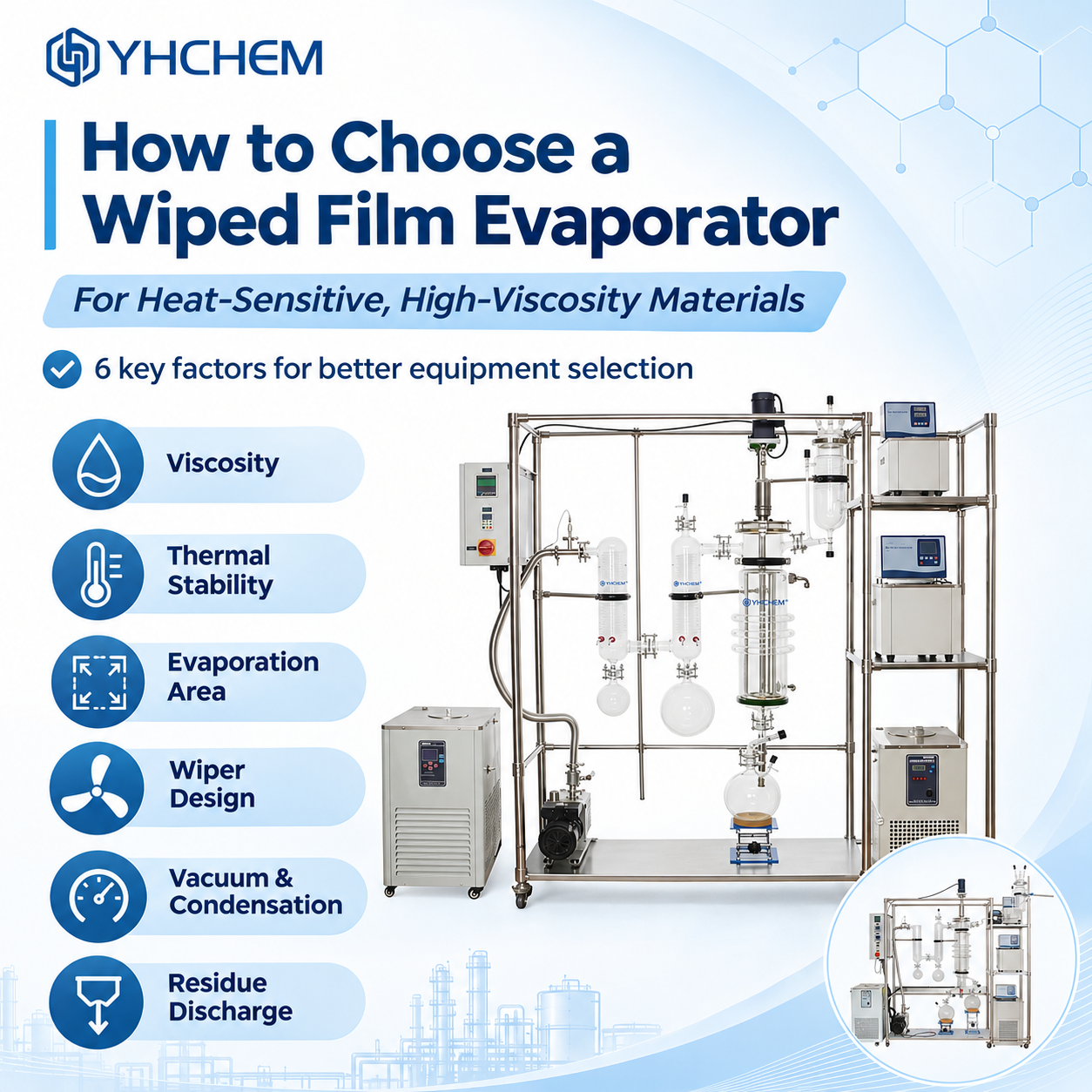
A wiped film evaporator should be selected according to the actual evaporation duty and feed properties under operating conditions—not by nominal throughput alone. For heat-sensitive or high-viscosity materials, key factors include viscosity at process temperature, viscosity increase during concentration, thermal stability, required evaporation area, wiper configuration, operating pressure, heating uniformity, condenser capacity and residue discharge. A material trial is often the most reliable way to confirm the process window before scale-up.
1. What Makes a Wiped Film Evaporator Suitable for Difficult Feeds?
A wiped film evaporator distributes feed over a heated cylindrical surface. A rotating wiper or scraper spreads and renews the liquid film while volatile components evaporate. Vapor moves to a condenser, while less volatile residue travels toward the discharge outlet. Mechanical film renewal can be useful for viscous, heat-sensitive or fouling-prone materials, but it does not make every solids-containing or highly viscous feed automatically suitable. Feedability, film formation, fouling and residue discharge must still be evaluated.
2. Start with the Separation Objective
First define the task: bulk solvent removal, light-component removal, continuous concentration, recovery of a volatile fraction, or pretreatment for a later purification step. The separation duty determines evaporation load, operating pressure and condensation requirements. Wiped film evaporation is commonly considered for evaporation and concentration. If the target is a high-boiling fraction requiring a very short vapor path and a nearby internal condenser, molecular distillation may also need evaluation. The technologies may be combined when the feed requires both bulk evaporation and further high-vacuum separation.
3. Evaluate Viscosity at Operating Conditions
Room-temperature viscosity alone is not enough. A feed may become much more viscous as solvent is removed, while some materials become easier to pump when heated. Collect viscosity data at feed temperature, during evaporation and at the expected residue-discharge temperature. Viscosity affects pump selection, inlet distribution, film thickness, heat transfer, wiper load and bottom discharge. If the concentrate thickens significantly, assess a jacketed feed tank, controlled preheating, heat tracing or a suitable discharge pump, while checking thermal stability and material compatibility.
4. Match Thermal Sensitivity with Residence Time and Heat Input
A renewed thin film can support heat transfer and reduce prolonged exposure on a heated surface. Actual thermal history still depends on wall temperature, product temperature, film thickness, feed rate, pressure, wiper design and residence behavior. Higher heating-medium temperature is not automatically better: excessive heat input may cause degradation, discoloration, side reactions or fouling. The objective is to supply enough heat for the required evaporation while keeping product exposure within an acceptable process window.
5. Size the Evaporation Area Based on the Actual Duty
Evaporation area is important, but it is not interchangeable with processing capacity. Required area depends on feed rate, the fraction to be evaporated, vapor-pressure behavior, latent heat, viscosity, operating temperature and achievable heat transfer. Start with a mass balance: feed entering, volatile fraction to be removed and residue expected. Then estimate sensible and latent heat duties and check whether the vapor load matches the condenser and vacuum system. Confirm whether a supplier's stated capacity means feed rate or evaporation rate and what reference material and operating conditions were used.
6. Check Wiper Design, Speed and Film Formation
The wiper distributes feed and renews the film. Its design, material, clearance and speed affect film coverage, shear, mechanical load and residue movement. The highest available speed is not necessarily the best. Too low a speed may provide insufficient film renewal for a particular feed; unnecessarily high speed may increase shear, entrainment, mechanical load or wear. Establish the operating range with the actual material and record speed, feed rate, product temperature, evaporation rate, residue flow and product quality.
7. Evaluate Vacuum, Heating and Condensation as One System
Vacuum selection should consider vapor and gas load, system tightness, seals, pump compatibility and pressure under feed—not only the pump's ultimate vacuum rating. The condenser must handle the expected vapor rate and heat load; insufficient condensation can destabilize operation and increase vacuum-system load. The heating jacket should provide sufficiently uniform and controllable heat. Review heating medium, circulation, temperature range and insulation together with vacuum and condensation.
8. Select Wetted Materials, Seals and Cleaning Arrangements
Check compatibility with the feed, solvents, cleaning agents and operating temperature. Review the vessel, rotor, wipers, feed and discharge lines, valves, gaskets and pump wetted parts. Borosilicate glass can be useful in laboratory development because the process is visible. Stainless steel is often considered for pilot and production systems where mechanical robustness or plant integration is important. YHCHEM's published glass YWF product information describes a system with a heating jacket, rotating scraper, condenser and vacuum system, and lists 316L stainless steel and PTFE for material-contact components. Confirm the exact wetted materials and seals for the selected model and feed.
9. Glass or Stainless Steel: Which Configuration Should You Choose?
For laboratory research and process development, a glass system can help operators observe feed distribution, film formation, foaming and residue behavior. For pilot or production applications, stainless steel may be appropriate when throughput, mechanical design or plant integration requires it. Do not decide by scale alone: corrosion resistance, solvent compatibility, temperature, pressure, cleaning and the need for process visibility all matter. Match the configuration to actual process data.
10. When Is Pretreatment or Another Technology Needed?
If the feed contains substantial water or low-boiling solvent, pretreatment or bulk solvent removal may reduce vapor load before the wiped film stage. If the material contains large particles, crystallizes rapidly or forms hard deposits, assess filtration, temperature conditioning and equipment design. If the target is a high-boiling, heat-sensitive fraction requiring a very short vapor path, molecular distillation may be more suitable for final separation. The correct route may be wiped film evaporation alone, pretreatment followed by wiped film evaporation, or wiped film evaporation followed by molecular distillation.
11. Information to Prepare Before Requesting Equipment
Prepare feed composition; viscosity at room and operating temperatures; expected viscosity after concentration; target fraction and components to remove; thermal stability and maximum acceptable product temperature; feed rate and batch or continuous mode; target concentration, purity and recovery; known pressure requirements; solids, crystals, foaming or fouling risks; and wetted-material and cleaning compatibility.
12. Why a Material Trial Matters Before Scale-Up
For high-viscosity and heat-sensitive feeds, calculations are only a starting point. Film formation, viscosity changes, foaming, fouling, residue discharge and product quality need to be assessed under representative conditions. A laboratory trial can establish a workable temperature, pressure, feed-rate and wiper-speed range, determine whether pretreatment is needed, and provide a more reliable basis for evaporation-area selection and scale-up.
Frequently Asked Questions
Is a wiped film evaporator suitable for high-viscosity materials?
It can be suitable for many viscous feeds because the rotating wiper helps distribute and renew the film. Suitability depends on viscosity at operating temperature, feedability, fouling behavior and residue discharge.
Is a wiped film evaporator suitable for heat-sensitive materials?
It is often evaluated for heat-sensitive materials because film renewal and controlled operation can limit prolonged heat exposure. Product temperature and thermal history must be verified for the specific feed.
Does a higher wiper speed always improve evaporation?
No. The appropriate speed depends on wiper design, viscosity, feed rate and film behavior. Excessive speed may increase shear, entrainment or mechanical load without improving the required separation.
How do I determine the required evaporation area?
Start with feed rate and mass balance, then evaluate the amount to evaporate, vapor-pressure behavior, viscosity, operating temperature and heat-transfer duty. Confirm the estimate with material testing or process data.
Should I choose a glass or stainless steel wiped film evaporator?
Glass is useful when visibility matters during laboratory development. Stainless steel may be preferred for pilot or production systems depending on scale, mechanical requirements and chemical compatibility.
Can a wiped film evaporator remove all solvents from a feed?
The achievable residual level depends on vapor-liquid behavior, pressure, temperature, residence behavior and condensation. Do not assume complete removal without material-specific validation.
Conclusion and CTA
The right wiped film evaporator is the one that matches the feed's real viscosity profile, thermal limits and separation duty. Evaporation area, wiper design, vacuum, heating, condensation, wetted materials and discharge should be evaluated as one integrated process. Share your material composition, viscosity, thermal limits, target concentration and required throughput with YHCHEM for a preliminary review of a glass or stainless steel YWF thin film evaporation system. For unfamiliar or difficult feeds, a material trial is recommended before final equipment sizing.
Recommended Internal Links
Table of Contents
- 1. What Makes a Wiped Film Evaporator Suitable for Difficult Feeds?
- 2. Start with the Separation Objective
- 3. Evaluate Viscosity at Operating Conditions
- 4. Match Thermal Sensitivity with Residence Time and Heat Input
- 5. Size the Evaporation Area Based on the Actual Duty
- 6. Check Wiper Design, Speed and Film Formation
- 7. Evaluate Vacuum, Heating and Condensation as One System
- 8. Select Wetted Materials, Seals and Cleaning Arrangements
- 9. Glass or Stainless Steel: Which Configuration Should You Choose?
- 10. When Is Pretreatment or Another Technology Needed?
- 11. Information to Prepare Before Requesting Equipment
- 12. Why a Material Trial Matters Before Scale-Up
- Frequently Asked Questions
- Conclusion and CTA
- Recommended Internal Links