
In recent years, the development and industrialization of peptide drugs, functional peptides, cosmetic active peptides, and peptide intermediates have accelerated significantly. Compared with conventional small molecules, peptides generally have more...
Share
In recent years, the development and industrialization of peptide drugs, functional peptides, cosmetic active peptides, and peptide intermediates have accelerated significantly. Compared with conventional small molecules, peptides generally have more complex structures, higher molecular weights, and greater sensitivity to heat. As peptide production moves from laboratory research to pilot and industrial scale, downstream processing becomes increasingly important.
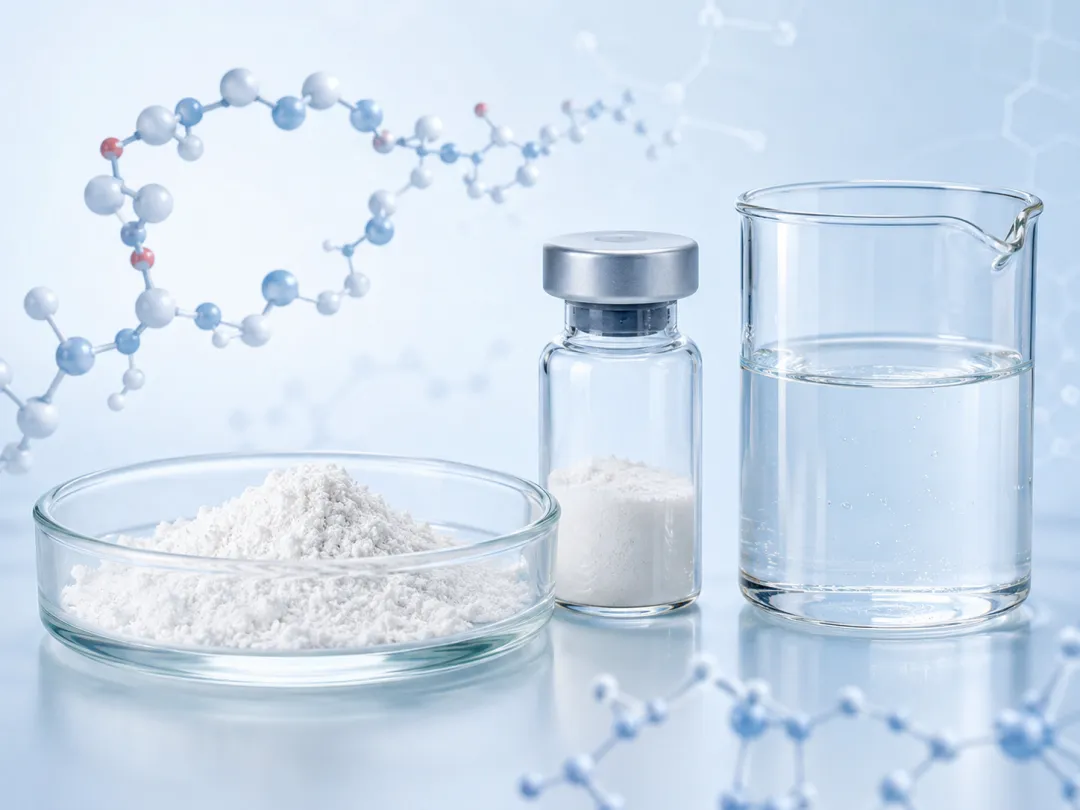
Peptide synthesis is only the first step. Purification, concentration, solvent removal, solvent recovery, and drying can directly affect product quality, yield, operating efficiency, and production cost.
For peptides produced by solid-phase peptide synthesis (SPPS), especially after preparative HPLC purification, large volumes of low-concentration fractions are often generated. Efficiently removing acetonitrile, water, and other solvents while minimizing thermal exposure is therefore a key challenge in peptide scale-up.
1. What Makes Peptide Downstream Processing Difficult?
A typical SPPS process includes deprotection, coupling, washing, cleavage, filtration, crude product treatment, HPLC purification, concentration, and freeze-drying.
After preparative HPLC, however, the collected fractions are not simply “peptide solutions.” They usually contain large amounts of water and acetonitrile, sometimes together with small amounts of acidic modifiers, while the concentration of the target peptide remains relatively low.
This creates several common processing challenges.
Challenge 1: Large HPLC Fraction Volumes Increase Freeze-Drying Load
Preparative HPLC commonly uses water and acetonitrile as mobile phases for gradient elution. The target peptide may be collected across multiple fractions, resulting in a large total liquid volume with a relatively low peptide concentration.
If these fractions are sent directly to a freeze dryer, the freezing and sublimation load increases significantly. This can extend the freeze-drying cycle and occupy valuable equipment capacity.
A practical solution is to introduce a wiped film evaporation step before freeze-drying.
Under vacuum, the boiling temperature of the solvents is reduced. The feed is continuously distributed into a thin film by the wiper system, allowing acetonitrile and part of the water to evaporate rapidly while the peptide remains mainly in the concentrated liquid phase.
This reduces the liquid volume entering the freeze dryer and transfers part of the solvent-removal duty to a more efficient pre-concentration stage.
Challenge 2: Peptides Are Heat-Sensitive
Some peptides are sensitive to temperature, pH, and oxidation conditions. In conventional batch evaporation, the material may remain in a heated vessel for an extended period.
As concentration increases, viscosity and local concentration may also rise. Prolonged heating can increase the risk of peptide degradation, aggregation, discoloration, or loss of activity.
For peptide concentration, the goal is therefore not simply to increase temperature and accelerate evaporation. A more suitable approach is to lower the evaporation temperature while minimizing residence time.
A wiped film evaporator operates under vacuum and continuously renews the liquid film on the heated surface. This improves heat transfer and allows volatile solvents to evaporate rapidly under relatively mild conditions, reducing the time the peptide remains in the heated zone.
Challenge 3: Acetonitrile Consumption Creates a Strong Need for Solvent Recovery
Acetonitrile is widely used as an organic mobile phase in preparative peptide HPLC. As production scales from laboratory to pilot and manufacturing levels, acetonitrile consumption can increase substantially.
If all acetonitrile/water mixtures are treated directly as waste liquid, both solvent consumption and waste-treatment pressure increase.
For suitable processes, a combined route can be considered:
Wiped Film Evaporation → Condensation → Solvent Recovery → Vacuum Distillation
The wiped film evaporator first removes volatile components such as acetonitrile and water from the peptide-containing solution. The vapor is then condensed and collected.
If a higher acetonitrile purity is required, the recovered solvent mixture can be further processed in a distillation column.
This configuration keeps the target peptide away from prolonged distillation conditions while allowing the distillation system to perform the task for which it is better suited: solvent separation and purification.
Challenge 4: Peptide Processes Cannot Simply Copy One Set of Parameters
Different peptides may vary significantly in molecular weight, sequence, initial concentration, solvent composition, viscosity, foaming tendency, crystallization behavior, and thermal sensitivity.
For this reason, one fixed combination of temperature, vacuum, feed rate, and concentration ratio cannot be applied to every peptide system.
For high-value materials, a more reliable scale-up route is:
Material Testing → Parameter Verification → Pilot Scale-Up → Production Equipment Design
Testing can be used to evaluate factors such as feed composition, acetonitrile/water ratio, processing capacity, maximum allowable temperature, target concentration ratio, vacuum level, feed rate, and wiper operating conditions.
This helps establish a stable operating window before moving to a larger system.
2. YHCHEM's Approach to Peptide Post-Processing
In a typical peptide downstream process, the wiped film evaporator is installed after HPLC purification to handle large volumes of low-concentration fractions.
Its primary task is rapid solvent removal and pre-concentration under vacuum, using thin-film formation and short residence time to reduce thermal exposure.
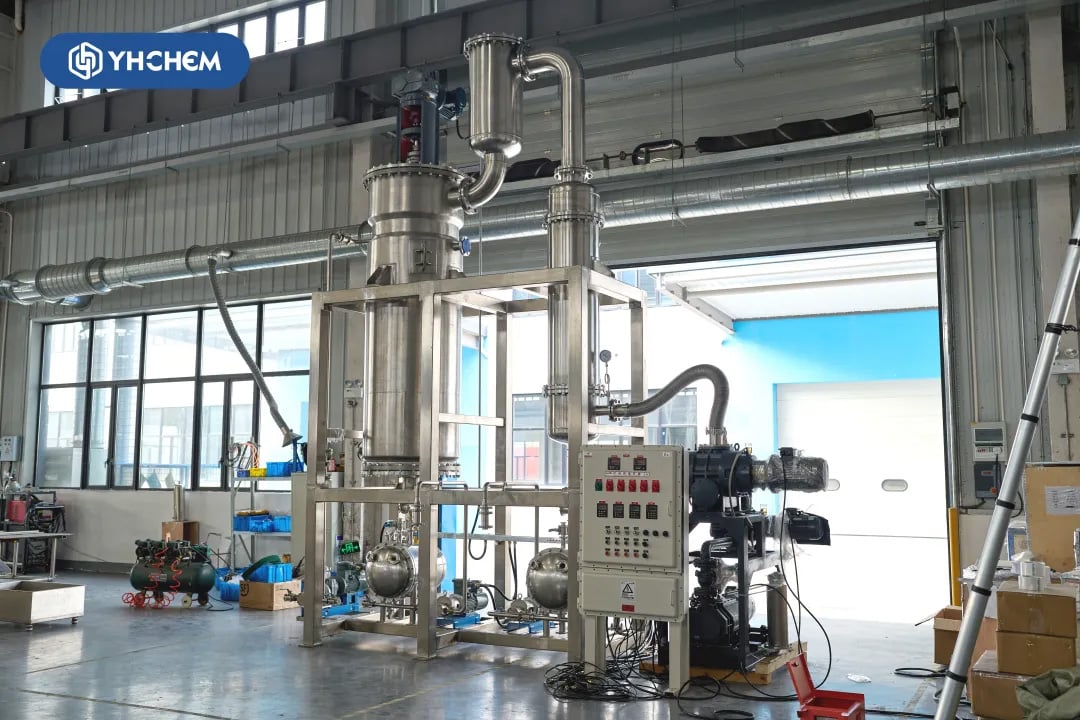
The condensed acetonitrile/water mixture can then be sent to a distillation system when further solvent purification or recovery is required.
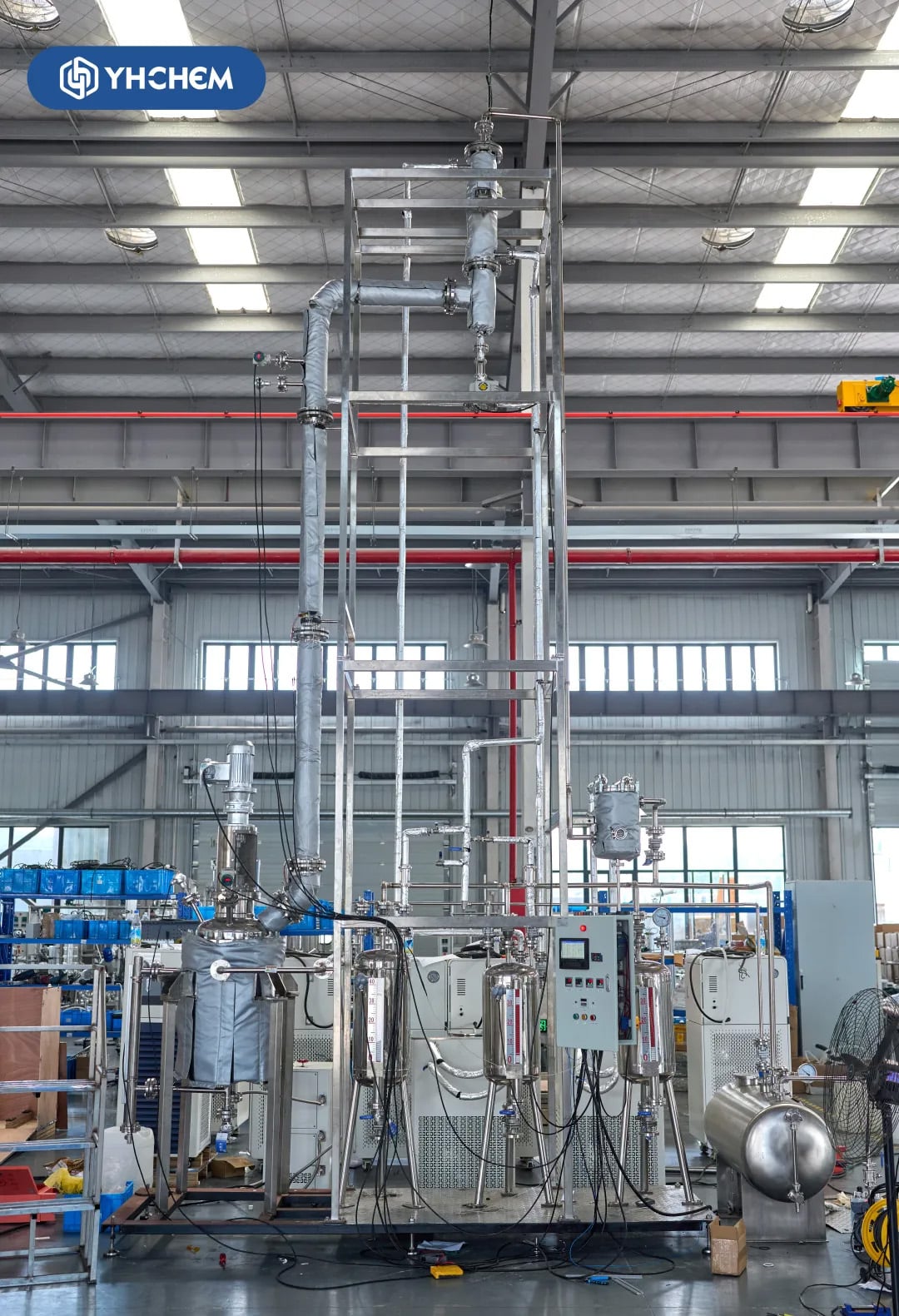
For certain special systems containing high-boiling, heat-sensitive, and sufficiently volatile organic components, molecular distillation may also be evaluated according to the actual physical properties of the material.
However, most peptides themselves have relatively high molecular weights and extremely low volatility. Molecular distillation is therefore generally not used as the primary method for directly purifying the target peptide.
The key is not to simply connect molecular distillation, wiped film evaporation, and distillation equipment in sequence. Each unit operation should perform the separation task best suited to its characteristics.
3. Why Use Wiped Film Evaporation for Peptide Concentration?
Several types of equipment can be used for solvent removal, including rotary evaporators, conventional batch vacuum evaporators, and wiped film evaporators.
Rotary Evaporators
Rotary evaporators are flexible and convenient for small laboratory batches. However, as processing volume increases, batch capacity, processing time, continuity, and solvent recovery efficiency may become limiting factors.
Batch Vacuum Evaporators
Batch vacuum evaporation can handle larger volumes, but the entire batch remains in the vessel during heating and concentration. For heat-sensitive and high-value peptide materials, prolonged thermal exposure needs to be carefully controlled.
Wiped Film Evaporators
In a wiped film evaporator, the material is continuously distributed into a thin film over the evaporation surface. Combined with vacuum operation, this enables rapid heat transfer and solvent evaporation.
Its main advantages for peptide concentration include:
Lower-temperature evaporation
Vacuum reduces the boiling temperature of acetonitrile, water, and other volatile solvents, allowing concentration under milder conditions.
Short residence time
The material passes rapidly through the evaporation zone rather than remaining in a heated batch vessel for an extended period.
Efficient heat transfer
The wiper continuously renews the liquid film, reducing heat-transfer resistance and improving evaporation efficiency.
Continuous processing
Continuous feeding and discharge make it easier to integrate the evaporator with upstream HPLC fraction collection and downstream condensation, solvent recovery, and freeze-drying.
Convenient solvent collection
Removed acetonitrile and water can be condensed and collected for further separation and recovery.
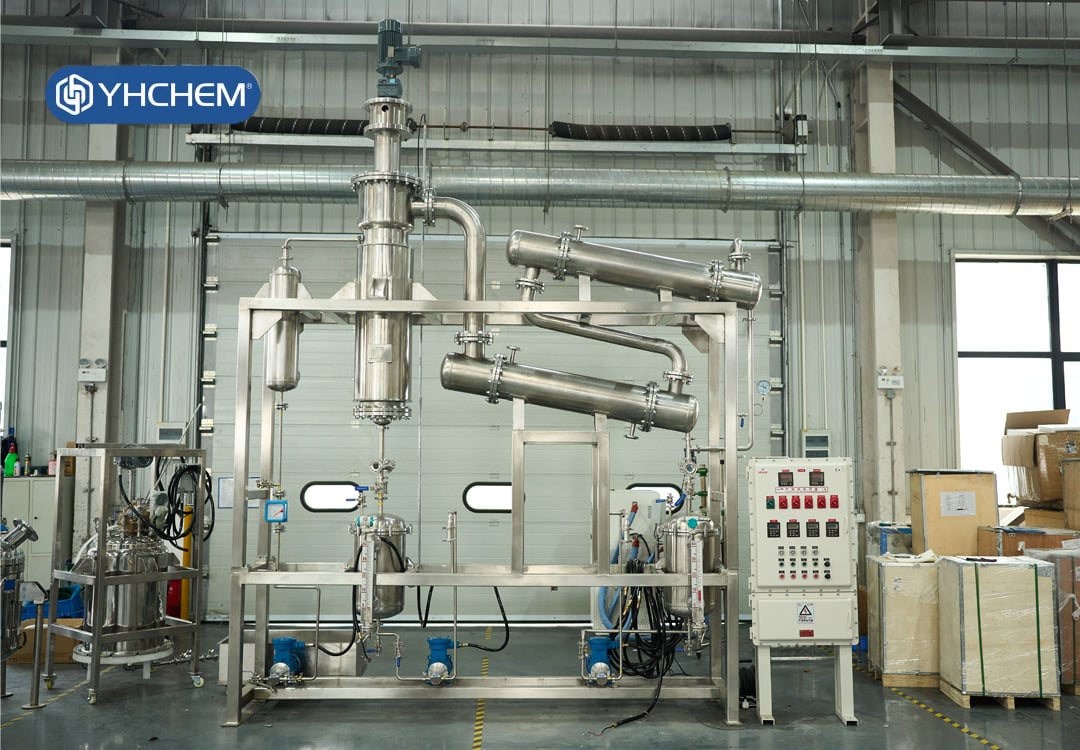
4. Scale-Up Is More Than Simply Making the Equipment Larger
Moving from gram-scale laboratory experiments to kilogram-scale or larger peptide production is not simply a matter of increasing vessel size.
The process itself must be scaled.
Key parameters include residence time, heat-transfer area, vacuum stability, condensation capacity, feed rate, concentration ratio, and endpoint control.
A rotary evaporator may perform well for a small laboratory batch, but when the liquid volume increases to tens or hundreds of liters, processing time, thermal history, and solvent recovery requirements can change significantly.
For high-value peptide materials, the equipment should therefore be designed around the material and process requirements rather than forcing the material to adapt to a fixed equipment configuration.
YHCHEM focuses on the complete development path from material testing and process parameter verification to pilot scale-up and continuous equipment design. Evaporation area, vacuum system, condenser capacity, equipment configuration, and automation can then be selected according to the actual process requirements.
5. Application Example: Concentration of Peptide Purification Fractions
A company in East China was scaling up a peptide process based on solid-phase synthesis and preparative HPLC purification.
As batch size increased, the volume of peptide-containing HPLC fractions also increased significantly. These fractions contained large amounts of water and acetonitrile, while the peptide concentration remained relatively low.
The company had previously used conventional batch evaporation for pre-concentration. With increasing throughput, however, the process faced longer concentration times, increased thermal exposure, and a higher freeze-drying load. The recovered acetonitrile/water mixture also lacked an effective recovery route.
Based on material analysis and preliminary process testing, the downstream process was adjusted to:
HPLC Purification → Wiped Film Evaporation → Peptide Concentrate → Freeze-Drying
During wiped film evaporation, vacuum reduces the solvent evaporation temperature. The feed is rapidly distributed into a thin film, allowing acetonitrile and part of the water to be removed within a relatively short residence time while the peptide remains mainly in the concentrated heavy phase.
The evaporated solvent is condensed and collected. When required, an additional vacuum distillation system can be used to further separate the recovered acetonitrile/water mixture.
This process transfers a substantial portion of the solvent-removal duty from the freeze dryer to the wiped film evaporator, reducing the liquid volume entering the freeze-drying stage and improving overall process continuity.
The resulting process can be summarized as:
Wiped Film Evaporation for Low-Temperature Peptide Concentration + Distillation for Solvent Recovery + Freeze-Drying for Final Product Preparation
Each unit operation performs a different function, helping reduce unnecessary thermal exposure while providing a practical basis for further scale-up.
Note: This example is based on a representative peptide downstream processing scenario. Actual equipment configuration and operating parameters should be determined according to material composition, processing capacity, product characteristics, and experimental results.

 EN
EN
 AR
AR
 BG
BG
 HR
HR
 DA
DA
 NL
NL
 FI
FI
 FR
FR
 DE
DE
 EL
EL
 HI
HI
 IT
IT
 JA
JA
 KO
KO
 NO
NO
 PL
PL
 PT
PT
 RO
RO
 RU
RU
 ES
ES
 SV
SV
 TL
TL
 ID
ID
 SR
SR
 UK
UK
 HU
HU
 TH
TH
 TR
TR
 GA
GA
 BE
BE
 BN
BN


