
 EN
 AR
 BG
 HR
 DA
 NL
 FI
 FR
 DE
 EL
 HI
 IT
 JA
 KO
 NO
 PL
 PT
 RO
 RU
 ES
 SV
 TL
 ID
 SR
 UK
 HU
 TH
 TR
 GA
 BE
 BN
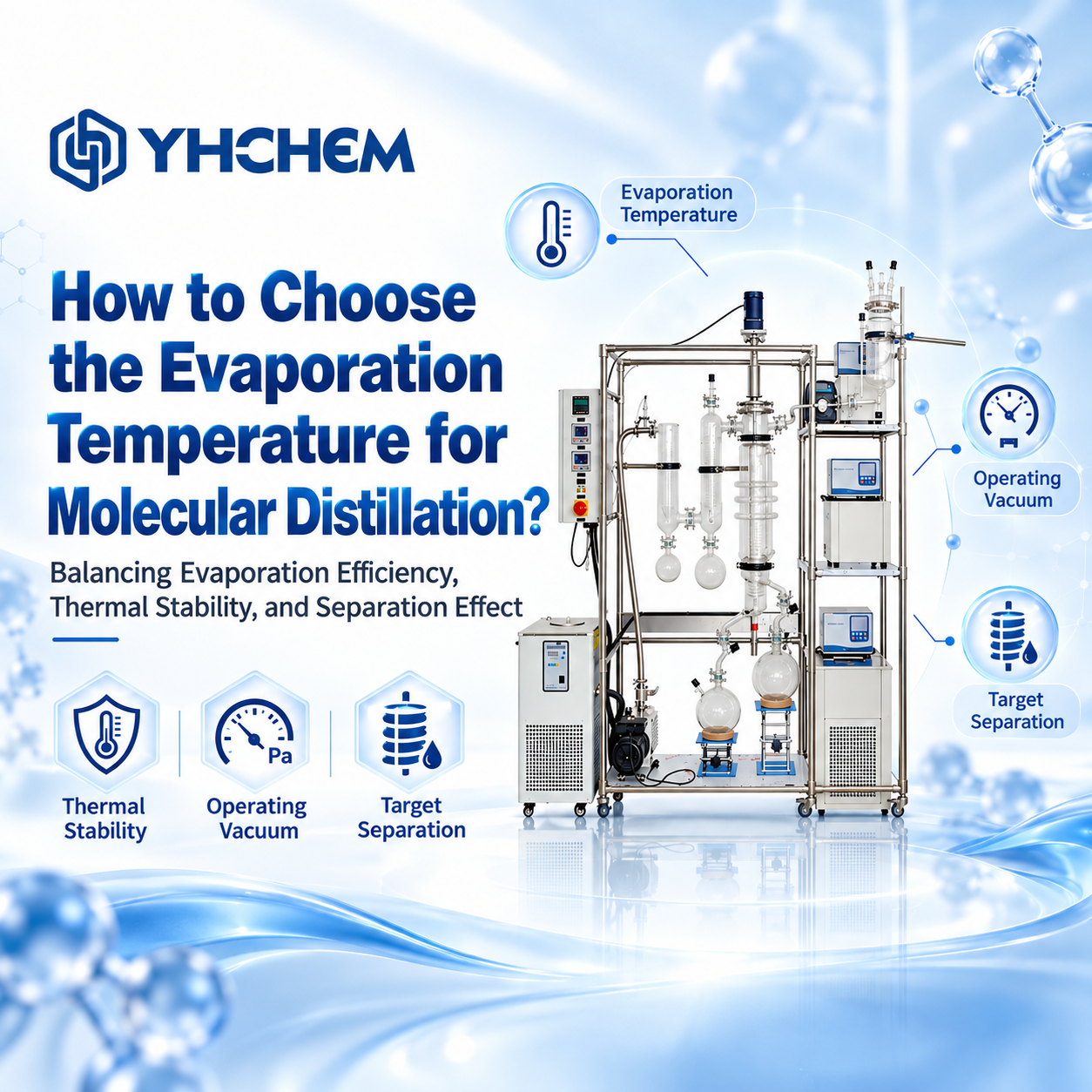
There is no single evaporation temperature that is correct for every molecular-distillation process. The useful temperature is the lowest practical temperature that gives sufficient evaporation of the target light fraction while maintaining stable vacuum, acceptable throughput and product quality. It must be selected together with operating pressure, feed composition, thermal stability, feed rate, film formation and condenser conditions.
Why Is There No Universal Molecular Distillation Temperature?
Two materials processed in the same molecular-distillation unit can require very different temperatures because their vapor-pressure behavior, viscosity, composition and thermal stability are different. Even the same material may need a different setting when the feed composition, target purity, throughput or vacuum level changes.
For this reason, the heater capability or maximum equipment temperature should never be used as the starting point for process selection. Start from the material and the separation target.
1. Start with the Separation Target
Before adjusting temperature, define what must leave the film and what should remain in the residue. Molecular distillation often separates lower-molecular-weight or more volatile fractions from a higher-boiling product, but the desired product may be either the distillate or the residue depending on the application.
A useful temperature window must therefore produce enough vaporization of the intended light fraction without causing excessive evaporation of valuable heavy components.
2. Vapor Pressure Is More Useful Than Boiling Point Alone
Atmospheric boiling point is not enough to select a molecular-distillation temperature because the process operates under high vacuum. What matters is the vapor pressure of the target and non-target components at the actual operating pressure and temperature.
If reliable vapor-pressure or thermodynamic data are available, they can provide a starting range. For multicomponent, viscous or poorly characterized materials, laboratory testing is usually needed because real film behavior and component interactions may differ from ideal predictions.
3. Vacuum and Temperature Must Be Optimized as a Pair
Reducing absolute pressure generally allows volatile components to evaporate at a lower temperature. If the operating vacuum becomes worse, a higher temperature may be needed to obtain a similar distillate rate. However, raising temperature to compensate for an unstable vacuum can increase thermal stress and may hide a vacuum-system or feed-pretreatment problem.
The practical objective is a stable pressure-temperature combination rather than the lowest pressure or the highest temperature by itself.
4. Do Not Confuse Feed Temperature, Evaporation-Surface Temperature and Heating-Medium Temperature
These temperatures describe different parts of the process and should not be treated as the same value.
- Feed temperature: the temperature of material entering the evaporator. Appropriate preheating can reduce the heating duty on the evaporation surface.
- Evaporation-surface or process temperature: the temperature associated with the heated film and the actual separation zone. This is the most relevant temperature when discussing evaporation performance.
- Heating-medium or jacket setpoint: the temperature of thermal oil, water or another heat-transfer medium supplying energy to the evaporator. It may be higher than the material temperature because heat must cross the equipment wall and liquid film.
When comparing trial data or supplier specifications, always confirm which temperature is being reported and where it is measured.
5. What Happens When the Evaporation Temperature Is Too Low?
If the temperature is below the useful operating window, the intended light fraction may not evaporate sufficiently. Typical signs can include:
- Very low or unstable distillate rate while vacuum is otherwise stable.
- Little difference between the light and heavy fractions.
- Target low-molecular-weight impurities remaining in the residue.
- Throughput becoming impractically low because the feed must move more slowly to obtain separation.
- A clear improvement in fractionation after a small, controlled temperature increase.
These observations should be confirmed with analytical results rather than judged only by collection volume.
6. What Happens When the Evaporation Temperature Is Too High?
Higher temperature can increase evaporation rate, but more evaporation is not automatically better separation. Excessive temperature can increase thermal degradation, color change, odor formation, polymerization or other unwanted reactions in sensitive materials.
It can also cause heavier components to enter the vapor phase, reducing fraction selectivity. Rapid vapor generation may increase vapor load, disturb the vacuum, contribute to foaming or entrainment, and overload the condenser.
7. Feed Rate Changes the Temperature Requirement
A higher feed rate increases the amount of material that must be heated and can increase both liquid-film thickness and vapor load. A temperature that works at a low trial feed rate may not provide the same result after throughput is increased.
For scale-up, temperature should therefore be evaluated together with feed rate, evaporation area and the ability of the vacuum and condensation system to handle the resulting vapor load.
8. Viscosity, Film Formation and Wiper Speed Also Matter
Molecular distillation depends on continuous formation and renewal of a thin liquid film. High viscosity, poor wetting or inappropriate wiper speed can reduce heat transfer and produce uneven residence behavior. In that situation, simply increasing temperature may not solve the real problem.
For viscous oils, resins, oligomers and similar materials, evaluate viscosity at the actual operating temperature, not only at room temperature. Wiper speed, feed rate and temperature should be developed as one operating window.
9. Condenser Performance Can Limit the Usable Temperature
As evaporation temperature rises, vapor load can increase. The internal condenser must remove the intended vapor fraction fast enough to prevent vapor accumulation and loss of vacuum stability. If condensation becomes insufficient, pressure can rise and the apparent benefit of higher temperature may disappear.
Condenser temperature, cooling capacity, condensable load and downstream cold traps should therefore be considered when increasing evaporation duty.
10. A Practical Way to Develop the Temperature Window
For an unfamiliar material, a controlled material trial is usually more reliable than choosing one temperature from literature or from another feed. A practical sequence is:
- Define the target fraction, required purity and maximum acceptable product temperature.
- Review feed composition, volatile content, viscosity and available vapor-pressure information.
- Establish a stable operating vacuum and adequate condensation before pushing evaporation duty.
- Start from a conservative temperature and stable feed rate.
- Increase temperature gradually while recording pressure, distillate rate, residue condition and visible stability.
- Analyze the light and heavy fractions rather than relying only on appearance or collection volume.
- Adjust feed rate and wiper speed after a useful temperature-pressure region is identified.
- Repeat the selected condition to confirm that the result is reproducible before scale-up.
Quick Diagnostic Guide
|
Observation |
Possible Interpretation |
What to Check Next |
|
Very little distillate |
Temperature may be too low, or target component is not sufficiently volatile |
Vacuum stability, vapor-pressure behavior, feed rate, temperature measurement |
|
Distillate rises after small temperature increase |
Operating window may have been below useful evaporation threshold |
Fraction analysis and product quality |
|
Color/odor changes or degradation |
Thermal exposure may be too high |
Lower temperature, deeper stable vacuum, shorter residence time |
|
Vacuum worsens as temperature rises |
Vapor load may exceed condensation or pumping capacity |
Condenser, cold trap, vapor load, feed rate |
|
Heavy fraction appears in distillate |
Selectivity may be decreasing or entrainment may be occurring |
Temperature, feed rate, wiper speed, foaming/entrainment |
|
Good result only at very low throughput |
Heat-transfer or vapor-handling capacity may be limiting |
Scale-up area, feed distribution, vacuum/condensation capacity |
Why Material Testing Is Often the Best Next Step
For specialty oils, silicone materials, resins, oligomers, botanical extracts, fragrance fractions and other multicomponent feeds, published boiling data may not fully predict real separation behavior. Thermal sensitivity, viscosity, foaming, film formation and interactions between components can all change the result.
A laboratory trial can identify a realistic pressure-temperature window, show whether pretreatment is needed and clarify whether the target product reports to the distillate or the residue. These data provide a stronger basis for pilot or production-scale equipment selection.
Frequently Asked Questions
Is a higher evaporation temperature always better?
No. Higher temperature may increase evaporation rate, but it can also increase degradation, vapor load, entrainment and non-target evaporation. Separation quality—not evaporation rate alone—should determine the setting.
How do I know if the temperature is too low?
Typical signs include very low distillate rate, insufficient removal of the target light fraction and little difference between fractions while the vacuum remains stable. Analytical results should confirm the diagnosis.
Can deeper vacuum reduce the required temperature?
Often yes, because lower absolute pressure can allow components to evaporate at lower temperature. The useful benefit depends on whether the vacuum can remain stable under real vapor load.
Should I use the heater setpoint as the molecular-distillation temperature?
Not without clarification. Heating-medium temperature, wall temperature and actual material/process temperature can be different. Record where each temperature is measured.
Can I copy a temperature from a similar material?
It can be a reference, but not a final operating condition. Feed composition, purity target, viscosity, vacuum level and equipment geometry can change the required window.
What data should I provide before a temperature trial?
Provide feed composition, volatile content, viscosity, thermal stability or maximum acceptable temperature, target fraction, target purity, expected throughput and any existing vacuum or distillation data.
CTA
Do not select molecular-distillation temperature from the equipment maximum or from one published number. Start with the material, establish a stable vacuum, and develop a repeatable pressure-temperature window. If you can provide feed composition, thermal stability, viscosity, target fraction and throughput, YHCHEM can help evaluate a suitable material-trial plan and equipment configuration.
Recommended Internal Links
- How Vacuum Affects Molecular Distillation Performance
- How to Select the Vacuum Level for Molecular Distillation
- What Materials Are Suitable for Molecular Distillation?
- Molecular Distillation Equipment / YMD Series
- Wiped Film Evaporator / YWF Series (for pretreatment when the feed contains substantial volatile solvent)
Table of Contents
- Why Is There No Universal Molecular Distillation Temperature?
- 1. Start with the Separation Target
- 2. Vapor Pressure Is More Useful Than Boiling Point Alone
- 3. Vacuum and Temperature Must Be Optimized as a Pair
- 4. Do Not Confuse Feed Temperature, Evaporation-Surface Temperature and Heating-Medium Temperature
- 5. What Happens When the Evaporation Temperature Is Too Low?
- 6. What Happens When the Evaporation Temperature Is Too High?
- 7. Feed Rate Changes the Temperature Requirement
- 8. Viscosity, Film Formation and Wiper Speed Also Matter
- 9. Condenser Performance Can Limit the Usable Temperature
- 10. A Practical Way to Develop the Temperature Window
- Quick Diagnostic Guide
- Why Material Testing Is Often the Best Next Step
- Frequently Asked Questions
- Recommended Internal Links