
 EN
 AR
 BG
 HR
 DA
 NL
 FI
 FR
 DE
 EL
 HI
 IT
 JA
 KO
 NO
 PL
 PT
 RO
 RU
 ES
 SV
 TL
 ID
 SR
 UK
 HU
 TH
 TR
 GA
 BE
 BN
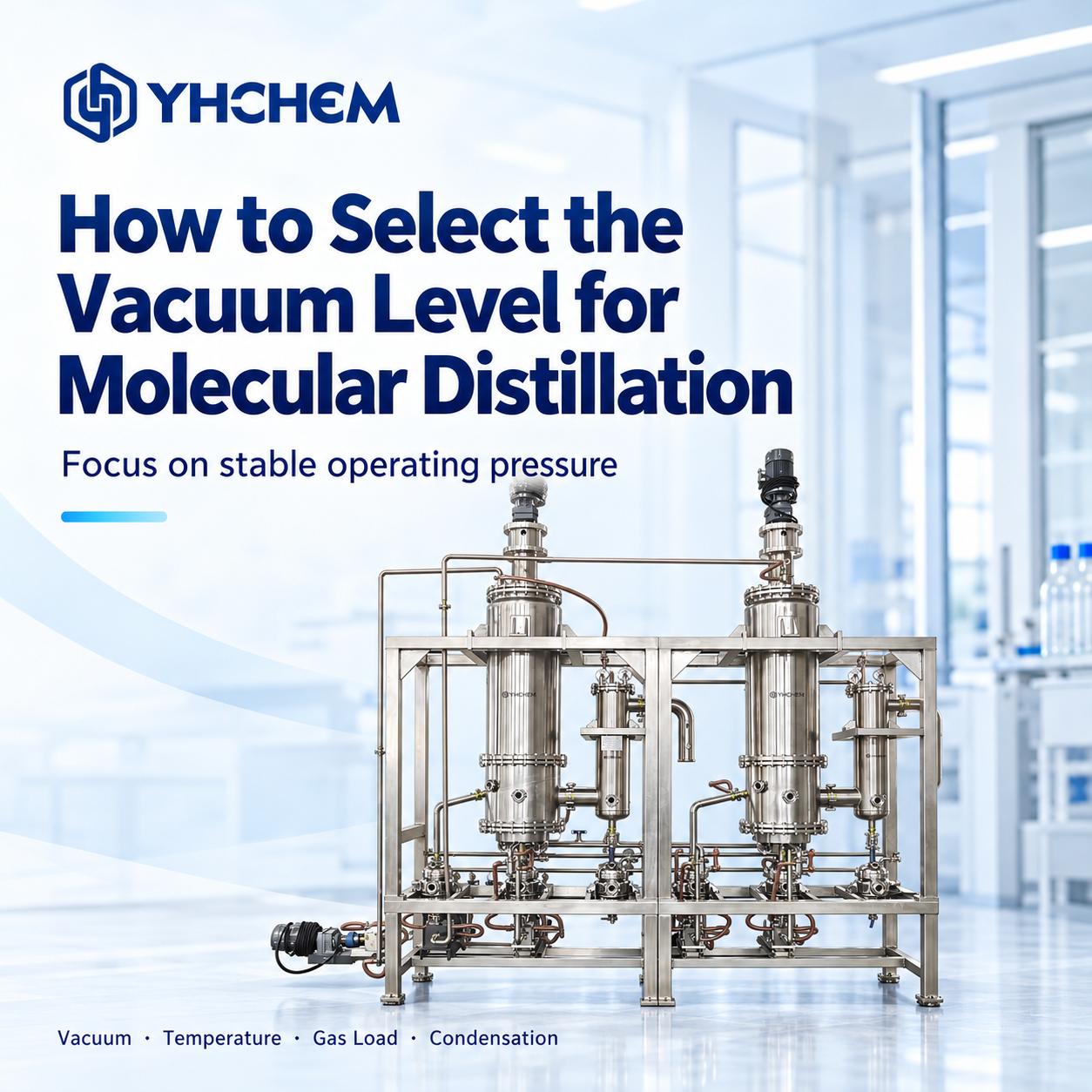
There is no single vacuum value that is correct for every molecular-distillation process. The required pressure is determined by the vapor pressure of the target component at an acceptable product temperature. Deeper vacuum generally allows evaporation at a lower temperature, but process performance also depends on gas load, condenser temperature, leaks, dissolved gases, feed rate and pressure drop through the system. The best operating point is therefore a process window rather than a single number.
Start from the material, not the pump specification
A vacuum pump may reach a very low blank-off pressure when the system is empty, but operating pressure with real material can be much higher. The feed continuously releases vapor, dissolved gases and residual solvent. The vacuum system must have enough pumping speed and conductance to maintain the required pressure while the process is running.
Too much vapor load can hide a good pump
If the feed contains water or volatile solvent, the molecular-distillation stage may receive an excessive vapor load. Pressure rises, evaporation temperature increases and separation can become unstable. In this case, upstream degassing or wiped film evaporation can be more effective than simply installing a larger vacuum pump.
Vacuum should be optimized together with temperature
Temperature and pressure should be adjusted as a pair. The aim is not to reach the lowest possible pressure at any cost; the aim is to achieve the required fractionation while protecting product quality and maintaining stable throughput. During a material trial, the pressure-temperature combination can be mapped against distillate rate, residue quality and product purity.
Key Takeaways
- Operating pressure is different from empty-system ultimate pressure.
- Feed degassing and solvent removal can greatly improve vacuum stability.
- Temperature and pressure should be optimized together.
- Vacuum conductance, seals and condenser performance are part of the same system design.
FAQ
Is lower vacuum always better?
Not necessarily. Once the required separation is achieved, going lower may add cost without improving the result.
Why does vacuum become worse after feeding starts?
Vapor and dissolved gases from the feed increase gas load. Leaks, insufficient condensation and undersized piping can also contribute.
Should the vacuum pump be selected only by ultimate pressure?
No. Pumping speed at the operating pressure, vapor handling and the complete vacuum path are equally important.
Suggested Internal Links
- Vacuum System Design for Molecular Distillation
- Pretreatment Before Molecular Distillation
- Molecular Distillation Temperature Selection
CTA
Provide YHCHEM with your feed composition, expected vapor load and target operating temperature to size the vacuum and condensation system around the process rather than around an empty-system pressure.
Technical note: final operating parameters depend on feed composition, thermal stability, viscosity, vapor pressure, target purity and equipment scale. Representative material testing is recommended when these data are uncertain.