
 EN
 AR
 BG
 HR
 DA
 NL
 FI
 FR
 DE
 EL
 HI
 IT
 JA
 KO
 NO
 PL
 PT
 RO
 RU
 ES
 SV
 TL
 ID
 SR
 UK
 HU
 TH
 TR
 GA
 BE
 BN
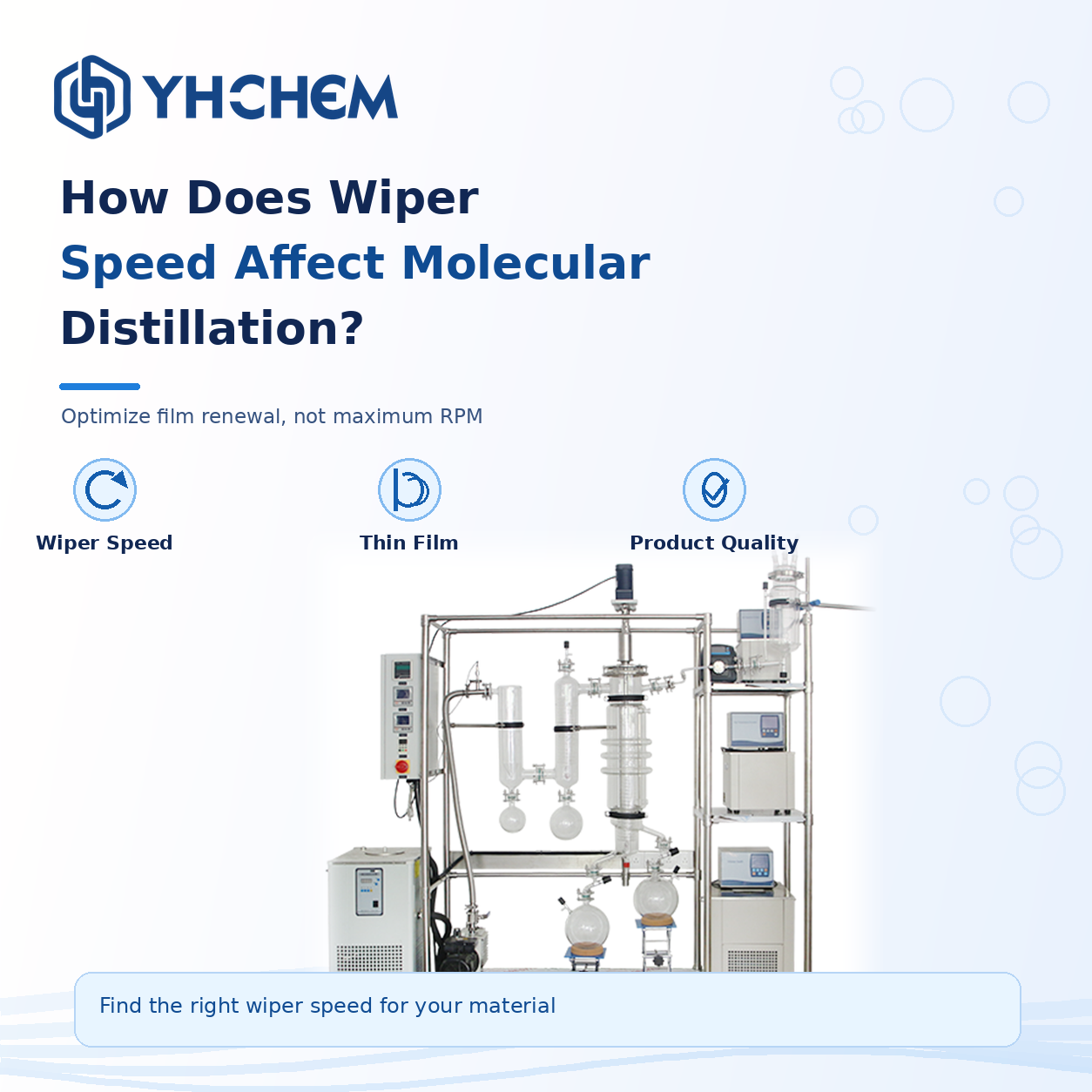
Wiper speed affects how molecular distillation feed is distributed and renewed as a thin film. It can influence heat transfer, evaporation behavior, liquid hold-up and residence-time distribution. However, higher rotational speed does not automatically mean a thinner film, a shorter residence time or higher purity. The result depends on the wiper design, feed rate, viscosity, evaporation intensity, operating temperature and vacuum. The practical goal is stable film formation and repeatable fraction quality, not the highest available rpm.
1. What Does the Wiper Do in Molecular Distillation?
A mechanical wiper or rotor spreads incoming liquid over the heated surface and continually renews the exposed film. This makes heat transfer more effective and reduces localized concentration or overheating in suitable designs. In a short-path unit, vapor from the film reaches an internal condenser positioned nearby. The wiper therefore supports the evaporation step, but it does not determine the separation on its own: vapor-pressure differences, condenser conditions and operating pressure still matter.
2. Why Film Formation Matters More Than RPM Alone
A stable film should distribute feed over the available heating area without excessive dry patches, thick moving ridges or persistent splashing. Wiper shape, clearance, wall geometry and liquid properties may be as important as shaft speed. Two units operating at the same rpm can create very different peripheral velocities and hydrodynamics if their rotor diameters or wiper types differ. Equipment comparisons should therefore specify the actual mechanical configuration, not only an isolated speed number.
3. Does Higher Speed Always Make the Film Thinner?
No universal relationship applies across all wiper arrangements. Increasing speed often changes mixing and surface renewal, but film thickness and liquid hold-up are controlled jointly by liquid load, viscosity, wiper geometry and evaporative loss. Depending on the hydrodynamic regime, a higher speed can also increase liquid accumulation in front of a blade or affect liquid distribution. Treat film quality as an observed result, not an assumed outcome of increasing rpm.
4. How Wiper Speed Affects Heat and Mass Transfer
Frequent film renewal can improve contact between material and the heated wall, which may support evaporation when product-side heat transfer is limiting. That benefit can diminish when other resistances dominate. More vigorous movement does not guarantee better fractionation if temperature, vacuum or condenser conditions are inappropriate. Evaluate distillate composition and residue quality together with collection rate: a higher light-fraction mass flow is not evidence of better selectivity by itself.
5. Wiper Speed and Residence Time: The Relationship Is Not Simple
Residence time depends on liquid loading, viscosity, gravity-driven flow, rotor structure and evaporation. Research on wiped-film equipment shows that the influence of speed can vary with wiper geometry and operating regime. In some conditions, speed changes liquid hold-up or the width of residence-time distributions rather than simply making everything pass through faster. For thermal-sensitive feeds, evaluate effective thermal exposure and product analysis instead of applying the rule “faster equals shorter residence.”
6. What If the Speed Is Too Low?
At unsuitable low speed, a specific rotor–feed combination may not distribute a viscous stream well, leaving uneven film coverage or localized high residence. Possible outcomes include weaker evaporation, unstable light/heavy fraction collection and increased risk of deposits. Yet some systems may work effectively at comparatively low speed. The appropriate minimum is set by the actual wiper design, feed condition and observed film behavior.
7. What If the Speed Is Too High?
Excessive speed may create unnecessary mechanical stress, power demand or agitation. With some feeds or geometries it can aggravate splashing, foam formation, entrainment or wear, although these effects must be confirmed experimentally. High speed also cannot compensate for overloaded feed, inadequate condenser duty or unstable vacuum. Raising rpm without observing product purity and equipment behavior may move the process away from its useful operating window.
8. Why Viscosity and Feed Rate Must Be Considered Together
Resins, silicone oils, polyurethane oligomers and certain botanical concentrates can change viscosity sharply as temperature and composition shift. At a fixed speed, higher feed rate increases the liquid load; at the same feed rate, a different viscosity changes how liquid moves across the wall. The rotor setting should be developed in combination with actual feed viscosity at process temperature, expected concentrated-residue viscosity and throughput rather than from an equipment brochure alone.
9. Interaction with Vacuum, Temperature and Condensation
Wiper speed indirectly changes the evaporation pattern and therefore may affect vapor generation. If increased vapor load makes the operating pressure unstable, a change in distillate rate may reflect the vacuum system rather than a direct separation benefit from wiping. Keep pressure, evaporation temperature, feed temperature, condenser duty and feed rate under control when testing speed. Adjusting several parameters at once makes the cause of a change difficult to identify.
10. A Practical Wiper-Speed Trial
Start with a safe equipment-approved speed range and characterize the material. With feed rate, working pressure, temperature and condenser conditions kept as consistent as practical, test a small number of incremental rotor settings. Record speed, motor load, pressure stability, visible film behavior where accessible, light and heavy fraction flow, mass balance, purity, color, fouling and signs of carryover. Repeat the most promising conditions. The preferred speed is the one that delivers reliable film behavior and the desired product specification with acceptable mechanical loading.
11. Questions to Resolve Before Scale-Up
Will the larger unit use the same wiper type and clearance? How do rotor diameter and peripheral speed compare? Does the material become more viscous as light components are removed? What changes in feeding and heat-transfer area occur at scale? Pilot testing or vendor evaluation is particularly valuable when transferring a laboratory setting to a larger rotor; the same rpm should not automatically be copied to another machine.
Frequently Asked Questions (FAQ)
Is faster wiper speed always better for molecular distillation?
No. Faster wiping may improve film renewal in some conditions, but it can also change hold-up, mechanical stress or entrainment. Product quality and stability should decide.
Does higher rpm always shorten residence time?
No. Residence-time behavior depends on wiper geometry, liquid load, viscosity and evaporation. Speed and residence time need not change monotonically.
Can wiper speed improve molecular distillation purity?
It can affect the film and evaporation behavior, but purity also depends on feed composition, pressure, temperature, condenser conditions and fraction collection.
Should viscous materials always use high speed?
Not necessarily. Viscosity matters, but rotor type, clearance, pumping characteristics and feed load must be considered together.
How should I choose a starting wiper speed?
Follow the equipment operating limits and carry out controlled material trials over an appropriate range, monitoring fraction quality, film behavior and motor load.
Conclusion / Process Evaluation
The correct wiper speed is a process condition, not an isolated specification. Stable film renewal and dependable product quality are more meaningful than maximum rpm. YHCHEM can review material viscosity, feed rate and equipment configuration and use representative trials to support process selection.
Recommended Internal Links
Table of Contents
- 1. What Does the Wiper Do in Molecular Distillation?
- 2. Why Film Formation Matters More Than RPM Alone
- 3. Does Higher Speed Always Make the Film Thinner?
- 4. How Wiper Speed Affects Heat and Mass Transfer
- 5. Wiper Speed and Residence Time: The Relationship Is Not Simple
- 6. What If the Speed Is Too Low?
- 7. What If the Speed Is Too High?
- 8. Why Viscosity and Feed Rate Must Be Considered Together
- 9. Interaction with Vacuum, Temperature and Condensation
- 10. A Practical Wiper-Speed Trial
- 11. Questions to Resolve Before Scale-Up
- Frequently Asked Questions (FAQ)
- Conclusion / Process Evaluation
- Recommended Internal Links