
 EN
 AR
 BG
 HR
 DA
 NL
 FI
 FR
 DE
 EL
 HI
 IT
 JA
 KO
 NO
 PL
 PT
 RO
 RU
 ES
 SV
 TL
 ID
 SR
 UK
 HU
 TH
 TR
 GA
 BE
 BN
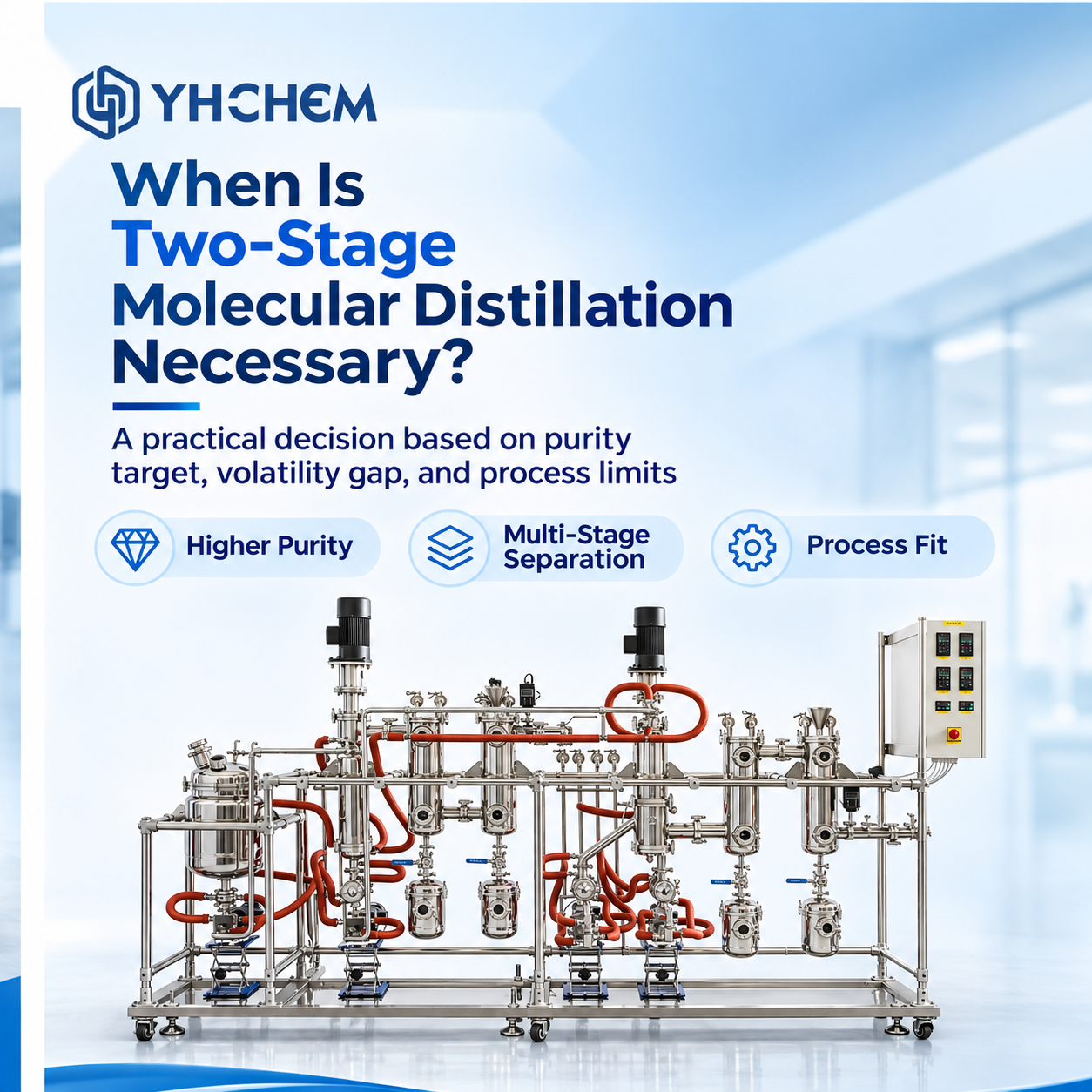
Two-stage molecular distillation is worth evaluating when one pass cannot achieve the required fraction purity, impurity removal or product recovery within a safe operating window. Different stages can be assigned different separation tasks, such as removing residual light fractions first and purifying a higher-boiling target later. However, a second stage does not automatically improve quality. Its value depends on what leaves in the distillate and what remains in the residue, the extra thermal exposure, and the measured purity–yield balance.
1. What Does “Two-Stage” Mean?
Two-stage molecular distillation generally means two distinct molecular-distillation steps arranged in a planned sequence. A fraction from the first step—either the distillate or the residue, depending on the target—is directed to the second step for another separation.
This is different from simply using a two-stage vacuum pump, adding two receivers to one evaporator, or making one pass through a single short-path unit. It is also different from a wiped-film evaporator used as pretreatment followed by only one molecular-distillation stage. These combinations can be useful, but they should be described accurately.
2. Why Can a Single Stage Be Insufficient?
A single molecular-distillation stage performs a finite fractionation under its chosen pressure, temperature, feed rate and condenser conditions. If the target and impurities have overlapping volatility distributions, a single cut may leave excessive unwanted components in the product.
Increasing temperature or the evaporated proportion may remove more impurities but can also carry valuable product into the wrong stream. This creates a trade-off between purity and recovery. Staging is one route to address that trade-off, not a guarantee of eliminating it.
3. Three Situations Where Two Stages May Help
First, the feed contains more than one relevant impurity group. A first stage may remove the more volatile fraction, allowing a second stage to focus on a narrower, higher-boiling separation.
Second, the first-stage product is close to specification but not yet acceptable. Further separation of the appropriate intermediate stream may reduce remaining impurities if useful vapor-pressure differences exist.
Third, the process needs both a defined product purity and acceptable recovery. Separating in stages and considering selective recycling may provide a better balance than trying to make a single aggressive cut.
4. Which Stream Should Go to the Second Stage?
There is no universal rule that the heavy fraction always enters the second stage. If the aim is to remove volatile impurities while retaining a valuable high-boiling product, the first-stage residue may become the second-stage feed. If the desired compound distills in the first stage and still needs polishing, the first-stage distillate may instead be processed again.
Each stage has at least two relevant material streams: distillate (light phase) and residue (heavy phase). The process should explicitly mark the target-containing stream, impurity-containing stream, expected losses and collection strategy before hardware is selected.
5. Example Process Route: Light Removal Followed by Target Separation
An illustrative route is: Feed → optional degassing or wiped-film solvent removal → Molecular Distillation Stage 1 → selected intermediate fraction → Molecular Distillation Stage 2 → target product.
In one configuration, Stage 1 removes residual volatile or low-molecular-weight material; Stage 2 then separates an additional high-boiling fraction. Stage temperatures or vacuum levels may differ, but they must be chosen from material volatility and thermal stability rather than from a fixed rule that each next stage must always be hotter or deeper in vacuum.
This route is a process concept, not a claimed YHCHEM test result or a universal flowsheet.
6. When Is a Single Stage or Pretreatment Better?
If the feed contains a large bulk amount of water or low-boiling solvent, a suitable degassing or wiped-film evaporation step may be more economical than adding a molecular-distillation stage to carry that vapor load.
If one pass already meets product specifications and recovery objectives with stable operation, a second molecular-distillation stage adds capital cost, vacuum-system complexity, energy use, cleaning and another opportunity for product loss. It may not be justified.
7. How to Evaluate Purity, Recovery and Mass Balance
For every stage, measure both light and heavy fractions and record their masses and key compositions. A useful evaluation reports product purity, target recovery, impurity removal and overall material-balance closure—not just a single “purity improved” statement.
Stage yield should be distinguished from total-feed-based yield: the second-stage recovery applies to material entering that stage, not necessarily to the original feed. Intermediate fractions sent to recycle or waste must be counted to avoid overstating performance.
8. Temperature, Vacuum and Residence Time Still Matter
Multiple passes may increase cumulative thermal exposure, even though each short-path stage is designed for relatively brief film residence. Stage pressure must be stable under actual vapor load, and condenser capacity must match the species expected to evaporate.
Feed preheating, wiper operation, viscosity, fouling tendency and phase behavior can change between stages as composition changes. Stage 2 should not simply copy Stage 1 settings.
9. How to Design a Representative Two-Stage Trial
Step 1: characterize the feed—composition, volatile content, viscosity, thermal limits and target fraction. Step 2: run a controlled single-stage baseline and analyze both outputs. Step 3: decide whether the distillate or residue should enter a second test. Step 4: test a limited pressure-temperature-feed-rate window while recording mass balance, product quality and energy or throughput constraints.
Compare the proposed two-stage route with the best validated single-stage route and, where relevant, a wiped-film pretreatment option. A process is justified only if the additional separation value exceeds the added cost and loss.
10. Typical Material Categories to Evaluate
Candidate tasks may include removing low-molecular-weight components from certain silicone oils, staged refinement of selected fatty-acid derivatives, specialty oils, resins, oligomers or fragrance fractions. The material name by itself does not demonstrate suitability. Composition, vapor pressure, chemical stability and target specifications must be evaluated.
For materials with very close volatilities, chemical instability or substantial solids/fouling risk, molecular distillation—whether one or two stages—may not be the right process.
11. What to Tell an Equipment Supplier
Provide the target product and impurity specifications, full or approximate feed composition, boiling/vapor-pressure information if available, viscosity at realistic temperatures, heat-sensitivity limits, feed throughput, acceptable product recovery and whether the desired product should be recovered in the light or heavy fraction.
For laboratory-to-pilot scale-up, also report the analytical methods used to judge performance, since apparent separation improvements can be misleading if measurements are inconsistent.
Quick Decision Guide
|
Process situation |
Usually evaluate first |
Why |
|
Large water/solvent load |
Degassing or wiped-film evaporation |
Remove bulk volatiles before deep-vacuum fine separation. |
|
One molecular stage meets purity and yield |
Single-stage molecular distillation |
Avoid unnecessary complexity and repeat heating. |
|
One stage is close, but leaves a measurable impurity fraction |
Two-stage trial |
Test whether the selected intermediate stream can be further refined. |
|
Purity improves at the cost of excessive valuable-product loss |
Staging / selective recycle study |
Check whether fraction routing improves the purity–recovery trade-off. |
|
Material changes or decomposes with repeated heating |
Alternative route or milder test |
More stages may worsen product quality. |
Frequently Asked Questions
Does two-stage molecular distillation always produce higher purity?
No. A second stage is useful only when the feed has separable remaining fractions and the additional step is operated appropriately. Some materials show little benefit or increased thermal damage.
Is two-stage molecular distillation the same as a two-stage vacuum pump?
No. A vacuum-pump arrangement describes pressure generation; a two-stage separation process means two distinct distillation operations.
Does the heavy fraction always feed Stage 2?
No. The target-containing intermediate stream may be a first-stage distillate or residue. The correct route depends on where the desired material partitions.
Should Stage 2 always run at a higher temperature?
Not necessarily. Pressure, composition, volatility and thermal limits determine each stage’s operating window.
Can wiped-film evaporation plus molecular distillation be called two-stage molecular distillation?
It is better described as a two-step or combined evaporation–distillation process unless there are actually two molecular-distillation stages.
What data can show whether a second stage is worth adding?
Analyze both first-stage fractions, calculate target recovery and impurity distribution, then compare a second-stage trial against the single-stage baseline and project economics.
Conclusion / Process Evaluation
A second molecular-distillation stage is a separation option—not an automatic upgrade. Start by defining the desired fraction and testing what a single stage can actually accomplish. If purity, impurity removal or recovery remain insufficient, a correctly routed two-stage trial can show whether further separation is technically and economically worthwhile. YHCHEM can review feed information and support process evaluation within the applicable laboratory, pilot and production equipment scope.
Recommended Internal Links
Table of Contents
- 1. What Does “Two-Stage” Mean?
- 2. Why Can a Single Stage Be Insufficient?
- 3. Three Situations Where Two Stages May Help
- 4. Which Stream Should Go to the Second Stage?
- 5. Example Process Route: Light Removal Followed by Target Separation
- 6. When Is a Single Stage or Pretreatment Better?
- 7. How to Evaluate Purity, Recovery and Mass Balance
- 8. Temperature, Vacuum and Residence Time Still Matter
- 9. How to Design a Representative Two-Stage Trial
- 10. Typical Material Categories to Evaluate
- 11. What to Tell an Equipment Supplier
- Quick Decision Guide
-
Frequently Asked Questions
- Does two-stage molecular distillation always produce higher purity?
- Is two-stage molecular distillation the same as a two-stage vacuum pump?
- Does the heavy fraction always feed Stage 2?
- Should Stage 2 always run at a higher temperature?
- Can wiped-film evaporation plus molecular distillation be called two-stage molecular distillation?
- What data can show whether a second stage is worth adding?
- Conclusion / Process Evaluation
- Recommended Internal Links